

Electrical and Electronic Engineering Courses and Diplomas: A Complete Guide
Introduction:
Electrical and electronic engineering courses teach learners how electrical power, circuits, machines, electronic devices and control systems operate. The right course depends on whether the learner wants to study a focused subject, establish a broad foundation at Level 4, progress to Level 5 or develop advanced engineering knowledge at Level 6.
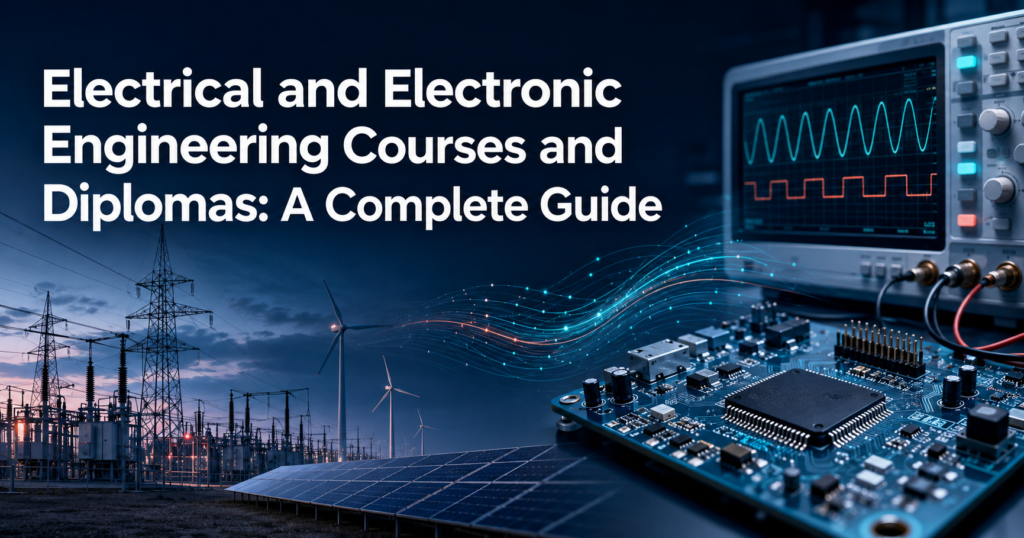
Although electrical and electronic engineering are closely connected, they have different areas of emphasis. Electrical engineering generally focuses on electrical power, machines, generation, distribution and larger-scale systems. Electronic engineering is more closely associated with circuits, semiconductors, digital systems, communications, sensors and control.
Many modern engineering systems combine both disciplines, which is why they are frequently studied together. This guide explains what electrical and electronic engineers study, the skills they develop, the career areas connected with the subject and the different online qualification routes available.
What is electrical and electronic engineering?
Electrical engineering is concerned with the generation, distribution, control and practical use of electrical energy. It includes systems such as generators, transformers, motors, electrical supplies, renewable-energy installations and power-distribution networks.
Electronic engineering focuses more closely on the components and circuits used to process information or control equipment. This includes semiconductors, amplifiers, digital circuits, sensors, communications equipment, embedded systems and electronic controllers.
There is considerable overlap between the two disciplines. An automated manufacturing system, for example, may contain electrical motors and power supplies alongside sensors, electronic circuits, programmable controllers and communication networks. Engineers working on renewable-energy systems, electric vehicles, robotics or industrial automation will often use knowledge from both areas.
What is the difference between electrical and electronic engineering?
A useful way to understand the distinction is to consider whether the main focus is energy or information.
Electrical engineers frequently work with energy. They may be involved in generating electrical power, distributing it safely, selecting electrical machines or improving the efficiency of an energy system.
Electronic engineers frequently work with information and signals. They may design or analyse circuits that measure conditions, process data, communicate information or control another device.
In practice, the boundary is flexible. Instrumentation and control engineering, telecommunications, robotics, renewable energy and automotive systems all bring electrical and electronic technologies together.
Someone interested in power generation, electrical machines, distribution networks or renewable-energy infrastructure may naturally lean towards electrical engineering. Someone more interested in circuit design, communications, digital systems, sensors or embedded technology may prefer electronic engineering.
A combined electrical and electronic engineering course provides exposure to both areas, allowing learners to develop a broad understanding before deciding whether to specialise further.
What will you study on an electrical and electronic engineering course?
The precise syllabus depends on the level and size of the qualification. A shorter diploma normally focuses on a smaller number of subjects, while a 120, 240 or 360-credit qualification provides progressively broader and deeper study.
Most learners begin with essential mathematical and scientific principles before learning how to calculate basic electrical parameters in DC circuits, including voltage, current, resistance, power and energy.
These foundations support more advanced circuit analysis and help learners understand how electrical components behave individually and as part of a larger system.
Specialist study can then include:
- electrical supplies and circuit principles;
- analogue and digital electronics;
- semiconductors, amplifiers and logic systems;
- transformers, motors and generators;
- digital engineering and electronic circuits;
- renewable electrical-energy systems;
- sensors, transducers and instrumentation;
- automation and control systems;
- telecommunications, networks and signal processing;
- engineering design, management and project work.
One of the fundamental principles connecting transformers, motors and generators is electromagnetic induction. Understanding this principle helps learners explain how changing magnetic fields produce voltage and enable electrical and mechanical energy to be converted from one form to another.
As learners progress through the academic levels, they move from understanding core principles towards analysing engineering problems, comparing possible solutions, justifying technical decisions and applying their knowledge to projects and unfamiliar situations.
What skills do electrical and electronic engineering students develop?
Technical knowledge is central to electrical and electronic engineering, but these courses also develop a wide range of analytical and professional skills.
Learners practise breaking complex systems into manageable sections, interpreting technical information and selecting suitable methods for solving problems. They develop mathematical reasoning, critical analysis, technical communication and the ability to explain why one engineering solution may be more appropriate than another.
Project-based study can also develop research, planning, risk analysis, time management and decision-making skills. These abilities are relevant across power generation, manufacturing, construction, transport, telecommunications, renewable energy, automation and other technical industries.
The UK National Careers Service identifies engineering science, mathematics, problem-solving, design, attention to detail, communication and computer skills as important areas for electrical and electronic engineering careers.[1][2]
What electrical and electronic engineering qualifications are available?
iLearn Engineering® provides several qualification routes, allowing learners to select a programme that reflects their existing knowledge, available study time and longer-term objectives.
| Qualification route | Academic level and credits | Suitable for |
|---|---|---|
| Diploma in Electrical and Electronic Engineering | EduQual Level 4, 40 credits | Focused study of electrical and electronic engineering principles |
| Higher International Certificate | EduQual Level 4, 120 credits | A broad foundation across core and specialist engineering subjects |
| Higher International Diploma | EduQual Level 5, 240 credits in total | More advanced study, including specialist subjects, engineering management and a substantial project |
| International Graduate Diploma | Level 6, 360 credits in total | Comprehensive engineering study incorporating Levels 4, 5 and 6 |
| International Graduate Diploma Top-Up | Level 6, 120-credit top-up | Level 6 progression for learners with an appropriate Level 5 engineering qualification |
Each qualification carries a defined academic level and credit value. The Higher International Certificate provides 120 credits at Level 4, the Higher International Diploma provides 240 credits across Levels 4 and 5, and the International Graduate Diploma provides 360 credits across Levels 4, 5 and 6.
This enables learners to choose a qualification that reflects the required depth and volume of engineering study.
Diploma in Electrical and Electronic Engineering
The Diploma in Electrical and Electronic Engineering is a focused 40-credit EduQual Level 4 qualification.
It consists of two 20-credit units. Engineering Mathematics is the recommended first unit, although it may be possible to replace it with another unit where the learner has suitable previous knowledge or a different area of interest. The core specialist unit covers electrical and electronic engineering principles.
This route may suit someone who wants to explore the subject, strengthen a particular area of knowledge or complete a smaller qualification before considering a longer programme.
Higher International Certificate at Level 4
The Higher International Certificate in Electrical and Electronic Engineering is a 120-credit EduQual Level 4 qualification.
It combines core study in engineering design, mathematics and science with specialist electrical and electronic engineering subjects. This creates a broad foundation and introduces the knowledge needed for progression into more advanced engineering study.
The qualification comprises six 20-credit units, including an optional unit that allows learners to explore another relevant engineering topic.
The specialist content includes electrical machines such as transformers, motors and generators. Learners interested in this area can read more about the operating characteristics of induction and synchronous motors.
Higher International Diploma at Level 5
The Higher International Diploma in Electrical and Electronic Engineering contains 240 credits in total.
The first 120 credits follow the Level 4 Higher International Certificate syllabus. Learners then progress to Level 5 study, including digital engineering and electronic circuits, renewable-energy electrical systems, engineering management and a substantial research and project-management unit.
This route is suitable for learners who want to develop greater technical depth, strengthen their analytical abilities and gain experience of planning and completing an independent engineering project.
The Higher International Diploma can also provide an academic platform from which learners can investigate further study and progression opportunities. Entry and credit-transfer requirements are determined by the receiving university or education provider.
International Graduate Diploma at Level 6
The International Graduate Diploma in Electrical and Electronic Engineering is a 360-credit Level 6 qualification incorporating study across Levels 4, 5 and 6.
Its Level 6 content includes advanced mathematics, machine learning and artificial intelligence, renewable energy, instrumentation and control, and communications, networks and signal processing. An optional unit enables learners to tailor part of the programme to their interests.
This pathway provides a substantial volume of engineering study, progressing from fundamental mathematical and scientific principles through to more advanced technical analysis and specialist applications.
A separate 120-credit Level 6 top-up route is available for learners who already hold an appropriate Level 5 engineering qualification. Previous qualifications can be reviewed before enrolment to determine the most appropriate starting point.
Which electrical and electronic engineering qualification should you choose?
The most appropriate route depends on what the learner already knows, the subjects they want to study and their intended outcome.
A 40-credit Diploma offers the shortest and most focused option. It can be useful for exploring the subject, developing targeted knowledge or completing a smaller accredited qualification.
The 120-credit Higher International Certificate provides a wider Level 4 foundation. It is suitable for someone who wants to study core engineering principles alongside specialist electrical and electronic subjects.
The 240-credit Higher International Diploma adds Level 5 study, engineering management and a major project. It may suit someone who wants to develop greater technical depth or build a more substantial academic portfolio.
The 360-credit International Graduate Diploma extends the pathway through to Level 6 and provides the broadest programme of study. Learners who already hold an appropriate Level 5 qualification can investigate the Level 6 top-up route.
Before choosing, it is useful to consider:
- existing qualifications and engineering experience;
- whether focused or broad-based study is required;
- the academic level needed;
- the amount of time available for study;
- the subjects most relevant to current work or career interests;
- the requirements of an employer, university, regulator or professional institution.
Can electrical and electronic engineering be studied online?
Electrical and electronic engineering contains mathematical, scientific and analytical content that can be studied through structured online materials, worked examples, technical resources and written assignments.
iLearn Engineering® courses are delivered online and asynchronously. Learners have access to their course materials without attending scheduled classes, allowing study to be organised around employment, family life and other commitments.
Assessment is completed through written coursework. There are no examinations, and learners submit their assignments when they are ready.
The online format is particularly suitable for autonomous learners who want control over their study schedule while retaining access to tutor support when required.
What careers are connected with electrical and electronic engineering?
Electrical and electronic engineering knowledge is applied across many industries. Potential areas include:
- power generation and distribution;
- renewable energy and battery systems;
- manufacturing and industrial automation;
- electrical machines and drives;
- electronics and semiconductor systems;
- telecommunications and networks;
- transport, rail and automotive technology;
- aerospace and defence;
- instrumentation and process control;
- building services and infrastructure;
- maintenance, testing and technical support.
Power engineers, for example, need to understand how electricity is transmitted efficiently and how transformers are used to change voltage levels. The article From Power Stations to Your Home: The Role of Transformers provides a more detailed introduction to transformer construction, operation and applications.
The National Careers Service explains that electrical engineers may design, test and maintain electrical systems, machinery and equipment. Electronics engineers may develop circuits, communications systems, control equipment and other electronic technologies.[1][2]
Employers commonly consider a combination of relevant qualifications, technical knowledge, practical experience and demonstrated competence when recruiting for engineering roles.
How can academic qualifications support professional development?
Academic study can form an important part of an engineer’s wider professional-development portfolio. It provides evidence of knowledge, analytical ability, technical understanding and continued learning.
Professional registration as an Engineering Technician, Incorporated Engineer or Chartered Engineer involves an individual assessment of professional knowledge, competence and commitment through a licensed professional engineering institution.
The Engineering Council explains that applicants can follow different routes towards registration. Relevant qualifications, workplace learning, professional experience and independently demonstrated competence can all contribute to an individual application.[3]
Learners interested in professional registration can contact the professional engineering institution most closely connected with their discipline for guidance on developing an appropriate portfolio of evidence.
What should international learners consider?
International learners can access iLearn Engineering® courses online from a wide range of locations.
The value of a qualification can depend on how the learner intends to use it. An employer may focus on its relevance to a particular job, while a university may examine its academic level, credits, syllabus and assessment. Government departments, professional bodies and credential-evaluation services may apply their own procedures.
International learners should therefore identify their intended outcome and consult the organisation responsible for that decision in their country. This might include an employer, university, professional institution, government department, qualifications authority or credential-evaluation service.
Providing the organisation with the qualification title, academic level, credit value, transcript and syllabus can help it undertake an informed assessment.
Compare the available electrical and electronic engineering routes
The most appropriate course is the one that fits the learner’s existing knowledge, intended outcome and realistic study commitment.
Explore the complete range of online electrical and electronic engineering courses, then compare the individual Diploma, Higher International Certificate, Higher International Diploma and International Graduate Diploma routes.
Learners who are unsure where to begin can contact iLearn Engineering® with details of their previous qualifications, professional experience and intended outcome so that the available routes can be explained.
Frequently asked questions
Which electrical engineering course is best for beginners?
Learners seeking a shorter introduction may consider the 40-credit Diploma. Those wanting a broader foundation across mathematics, science, engineering design and specialist electrical subjects may prefer the 120-credit Higher International Certificate.
Should I choose electrical or electronic engineering?
Electrical engineering may appeal more to learners interested in power, machines, energy and distribution systems. Electronic engineering may appeal more to those interested in circuits, signals, semiconductors, communications and control. A combined course provides experience of both areas.
Can electrical engineering be studied while working full-time?
The asynchronous delivery model allows learners to organise their studies around employment and other commitments. The time required will depend on the size of the qualification, the learner’s existing knowledge and the number of hours available each week.
How can an electrical engineering qualification support career progression?
A qualification can strengthen technical knowledge, demonstrate continued professional development and contribute to a broader portfolio of qualifications and experience. The way it supports progression will depend on the role, employer and learner’s existing experience.
References
- National Careers Service: Electrical engineer
- National Careers Service: Electronics engineer
- Engineering Council: Becoming professionally registered
Interested in our Engineering Courses?
At iLearn Engineering®, we offer a diverse range of online accredited Engineering courses and qualifications to cater to different academic and career goals. Our civil courses are available in varying credit values and levels, ranging from 40 credit Engineering Diplomas to a Bachelor’s equivalent 360 credit International Graduate Diploma.
Recent Posts
Why a Headwind Reduces Take-Off Distance: The Airspeed–Groundspeed Derivation
Why a Headwind Reduces Take-Off Distance: The Airspeed–Groundspeed Derivation Aeroplanes normally take off into wind because the wing must reach a required airspeed to produce lift, whereas the runway distance is travelled at groundspeed. A headwind contributes to the airspeed before the aircraft has covered any runway. It therefore reduces the groundspeed required at lift-off […]
How to Calculate Aircraft Take-Off Ground Run: A Flight Mechanics Tutorial
How to Calculate Aircraft Take-Off Ground Run: A Flight Mechanics Tutorial An aircraft does not become airborne simply because its engines are producing thrust. During the take-off ground run, thrust must overcome aerodynamic drag and rolling resistance. On a sloping runway, it must also overcome a component of the aircraft’s weight. This tutorial derives a […]
Types of Aircraft Drag Explained: Induced, Profile and Interference Drag
Types of Aircraft Drag Explained: Induced, Profile and Interference Drag An aircraft experiences several forms of aerodynamic drag at the same time. Some result from generating lift, some arise as air flows over the aircraft’s surfaces, and others are created when airflow around neighbouring components interacts. For a conventional aircraft in subsonic flight, total drag […]