

How Aerofoils Generate Lift: A Beginner’s Guide to Angle of Attack, Camber and Pressure Distribution
An aerofoil does not create lift simply because its upper surface is curved. Lift is produced because the aerofoil meets the airflow at a suitable angle and shape, causing a pressure distribution that results in an aerodynamic force.
For aircraft engineers, this matters because the same wing can produce different amounts of lift as airspeed, angle of attack and configuration change. Understanding these relationships is the starting point for interpreting wing design, aircraft performance and stall behaviour.
What is an aerofoil?
An aerofoil is the cross-sectional shape of a wing, tailplane, propeller blade or other lifting surface. It is designed to guide air in a controlled way so that an aerodynamic force is produced.
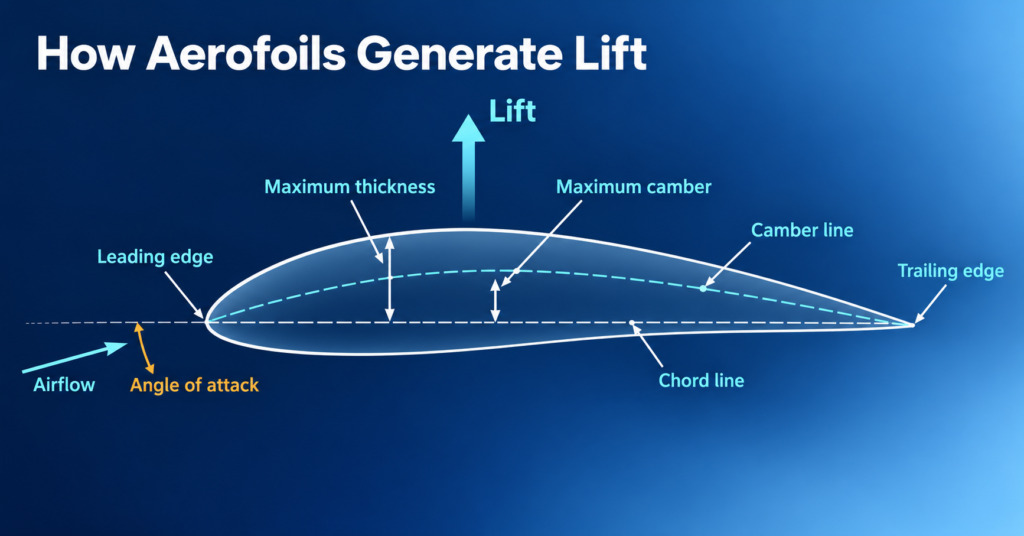
Several features are important:
- Leading edge: the front of the aerofoil, where the airflow first meets it.
- Trailing edge: the rear of the aerofoil, where the flows from the upper and lower surfaces leave the section.
- Chord line: an imaginary straight line joining the leading and trailing edges.
- Camber: the curvature of the aerofoil’s mean line. A cambered aerofoil is not symmetrical about its chord line.
- Angle of attack: the angle between the chord line and the relative airflow.
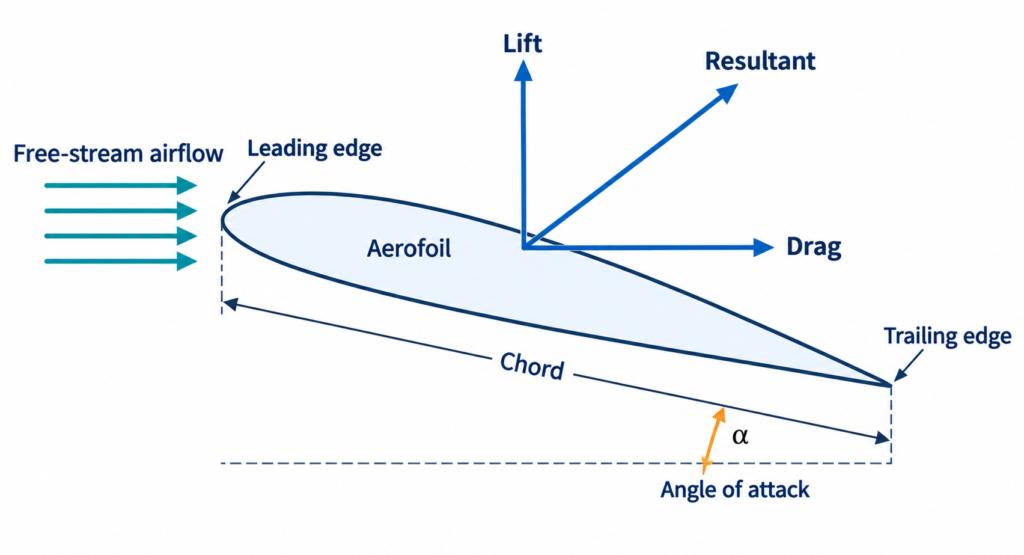
The relative airflow is the direction from which the air appears to approach the aircraft. In steady level flight, it is approximately opposite to the aircraft’s flight path.
How does an aerofoil generate lift?
As air flows around an aerofoil, its velocity and pressure vary across the surface. The resulting pressure distribution acts over the aerofoil’s area and produces an aerodynamic force.
That force can be resolved into two components:
- Lift, acting perpendicular to the relative airflow.
- Drag, acting parallel and opposite to the relative airflow.
For a lifting aerofoil, the pressure is commonly lower over much of the upper surface and relatively higher over parts of the lower surface. This pressure difference contributes to an upward force. At the same time, the aerofoil turns the airflow downwards. The downward change in the air’s momentum is associated with an upward reaction force on the aerofoil.
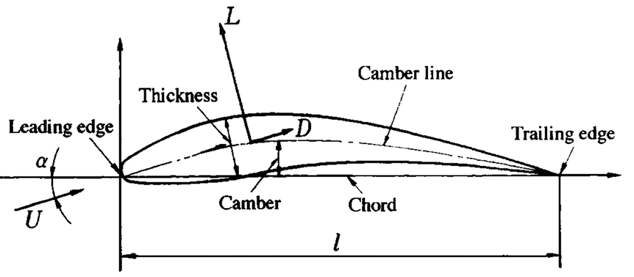
Both descriptions are useful. Pressure distribution is how engineers calculate the surface forces, while the downward deflection of the airflow helps explain the overall momentum change. They describe the same aerodynamic interaction from different viewpoints. NASA’s aerodynamic guidance similarly explains that variations in airflow velocity create pressure variations over a body, and that integrating the pressure over the surface produces the aerodynamic force. [1]
Why angle of attack is so important
Angle of attack is one of the most direct ways of changing the lift produced by a wing.
At a small positive angle of attack, an aerofoil turns the airflow downwards and develops a pressure distribution that produces lift. Increasing the angle of attack generally increases lift at first. This is why an aircraft can rotate for take-off: raising the nose increases the wing’s angle of attack and allows it to generate more lift.
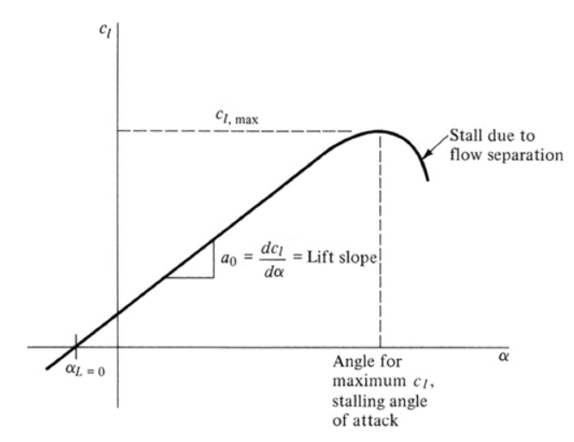
The relationship is often shown using the lift coefficient, CL. For a particular aerofoil at low angles of attack, CL usually rises approximately linearly as angle of attack increases.
Lift can be represented by:
L = ½ ρV²SCL
Where:
- L is lift in newtons;
- ρ is air density in kg/m³;
- V is airspeed in m/s;
- S is wing reference area in m²; and
- CL is the lift coefficient.
The equation shows that lift is affected by more than aerofoil shape. A wing can generate more lift by flying faster, operating in denser air, increasing its effective area with high-lift devices, or increasing its lift coefficient through angle of attack and configuration.
Camber: why shape matters
Camber changes how an aerofoil behaves at a given angle of attack.
A symmetrical aerofoil has the same upper and lower profile. At zero angle of attack in ideal, symmetrical conditions, it produces little or no lift. Symmetrical sections are often useful where predictable behaviour in both positive and negative lift is needed, such as on some aerobatic aircraft tail surfaces.
A cambered aerofoil has greater curvature on one side than the other. It can produce positive lift even when its chord line is aligned closely with the relative airflow. This makes cambered aerofoils useful for many conventional aircraft wings, particularly where efficient low-speed lift is important.
However, greater camber is not automatically better. It can increase the lift available at low angles of attack, but it may also affect pitching moment, drag and the aerofoil’s suitability for its intended flight condition. An aerofoil for a glider, training aircraft, high-speed jet and wind turbine blade will therefore not be identical.
Pressure distribution around the aerofoil
Pressure is not uniform around a lifting aerofoil.
Near the leading edge, the flow accelerates and changes direction rapidly. This often creates a region of relatively low pressure over the upper surface, sometimes called the leading-edge suction peak. Further along the aerofoil, the pressure gradually recovers towards the trailing edge.
On the lower surface, pressure may be higher than the surrounding free-stream air over part of the aerofoil. The exact pattern depends on the aerofoil’s geometry, angle of attack, Reynolds number, surface condition and the condition of the airflow.
Engineers examine pressure distributions because they reveal far more than the total lift force. They can help identify:
- whether an aerofoil is operating efficiently;
- where flow separation may begin;
- how a flap or slat changes the load on the wing;
- whether pressure recovery is too severe; and
- how the centre of pressure and pitching moment may change.
This is why wind-tunnel testing is valuable. Pressure taps and other instruments allow engineers to measure pressure at multiple points on a model, building a detailed picture of how the airflow behaves. For a closer look at this process, see how wind tunnels use pressure measurements to test aircraft aerodynamics.
What happens when the angle of attack becomes too high?
Increasing angle of attack does not increase lift indefinitely.
At a sufficiently high angle, the boundary layer—the thin region of air close to the surface—can no longer remain attached to the aerofoil. The flow separates, the pressure distribution changes significantly and lift reduces or becomes unstable. This condition is known as a stall.
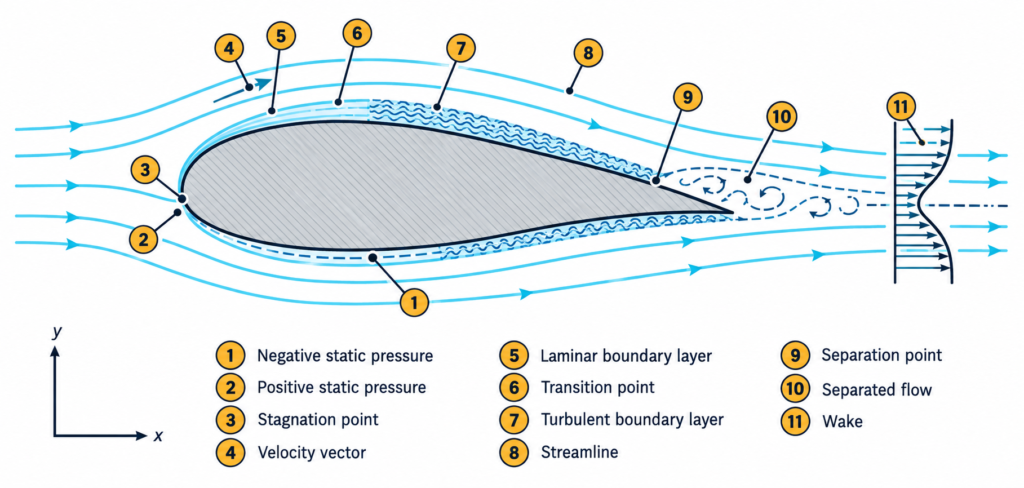
A stall is therefore primarily an angle-of-attack problem, not simply a low-speed problem. Low airspeed makes a stall more likely because the aircraft needs a higher angle of attack to produce the lift required to support its weight. However, a wing can stall at a range of speeds if its critical angle of attack is exceeded.
The precise stall angle depends on the aerofoil, wing design, surface condition, flap setting, Reynolds number and atmospheric conditions. NASA notes that lift changes approximately linearly at lower angles for a typical aerofoil, while boundary-layer separation at higher angles leads to a loss of lift. [2]
A practical example: take-off
Consider an aircraft accelerating along a runway. At first, the wing may not generate enough lift to support the aircraft’s weight because the airspeed is low.
As speed increases, the V² term in the lift equation increases rapidly. Near rotation speed, the pilot raises the nose slightly. This increases the angle of attack, increasing CL and helping the wing generate the required lift.
Aircraft designers must ensure this process provides a safe margin. The wing needs to generate sufficient lift for take-off without operating unnecessarily close to stall, while the aircraft’s tailplane and control surfaces must provide the required pitch control.
From aerofoil theory to aircraft performance
Aerofoil theory is a foundation, not the whole aircraft story. A real wing has finite span, wing tips, flaps, structural deflection and interference effects from the fuselage, engines and tail surfaces. These features influence drag, stability, control and the lift distribution across the wing.
Nevertheless, the basic principle remains the same: aerofoil shape and angle of attack establish a pressure distribution; the pressure distribution produces aerodynamic forces and moments; and those forces determine how an aircraft climbs, cruises, turns and lands.
For a broader explanation of the forces acting on an aircraft, read What Really Keeps an Aircraft Flying?. To explore how the lift-to-drag ratio affects unpowered flight, see Mastering the Glide: How Aircraft Fly Without Thrust.
Develop your understanding of aerodynamics
The Diploma in Aerodynamics at iLearn Engineering® develops knowledge of aerodynamic forces and moments, aerofoils and wings, flow behaviour and aircraft design. It is a 40-credit Level 6 course studied online through coursework.
For learners seeking a broader aerospace route, the Higher International Certificate in Aerospace Engineering, Higher International Diploma in Aerospace Engineering and International Graduate Diploma in Aerospace Engineering provide wider structured study pathways.
Frequently asked questions
Does a wing need a curved upper surface to generate lift?
No. A symmetrical aerofoil can generate lift when it operates at a positive angle of attack. Camber changes the lift characteristics, but angle of attack remains fundamental.
Is lift caused by faster air over the top of a wing?
The airflow velocity and pressure distribution around an aerofoil are linked, but “faster air over the top” alone is an incomplete explanation. Lift results from the complete pressure distribution and the aerofoil’s downward turning of the airflow.
Does an aircraft stall because it is flying too slowly?
An aircraft stalls when its wing exceeds its critical angle of attack. Flying slowly often requires a higher angle of attack, which is why stalls are more likely at low speed.
References
[1] NASA Glenn Research Center: Aerodynamic Center
[2] NASA Glenn Research Center: Inclination Effects on Lift
Interested in our Aerospace Engineering Courses?
At iLearn Engineering®, we offer a diverse range of online accredited aerospace engineering courses and qualifications to cater to different academic and career goals. Our aerospace courses are available in varying credit values and levels, ranging from 40 credit Engineering Diplomas to a Bachelor’s equivalent 360 credit International Graduate Diploma.
All Aerospace Engineering Courses
All Aerospace Engineering Diploma Courses can be seen here.
Short Aerospace Courses (40 Credits)
- Diploma in Aerospace Engineering
- Diploma in Aircraft Design
- Diploma in Principles of Flight
- Diploma in Aerospace Structures
- Diploma in Aerodynamics
- Diploma in Aerodynamics, Propulsion and Space
First Year of Undergraduate (Level 4 – 120 Credits)
Higher International Certificate in Aerospace Engineering
Years One and Two of Undergraduate (Level 5 – 240 Credits)
Higher International Diploma in Aerospace Engineering
International Graduate Diploma (Level 6 – 360 Credits)
International Graduate Diploma in Aerospace Engineering
Complete Engineering Course Catalogue (all courses)
Alternatively, you can view all our online engineering courses here.
Recent Posts
Why There Is No Perfect Aerofoil: The Design Trade-Offs Behind Every Aircraft Wing
Why There Is No Perfect Aerofoil: The Design Trade-Offs Behind Every Aircraft Wing If a designer could create a perfect aerofoil, it would produce very high lift with almost no drag, remain stable at every angle of attack, fit a lightweight structure inside the wing and work equally well at low and high speed. No […]
Why Aircraft Engine Intakes Use Diffusers: Slowing Air to Recover Pressure
Why Aircraft Engine Intakes Use Diffusers: Slowing Air to Recover Pressure An aircraft engine needs a large, steady supply of air at its compressor face. That may sound simple, but the air approaching an aircraft is moving quickly, often with changes in direction, velocity and pressure caused by the aircraft’s shape and flight condition. An […]
How Wind Tunnels Use Pressure Measurements to Test Aircraft Aerodynamics
How Wind Tunnels Use Pressure Measurements to Test Aircraft Aerodynamics Before an aircraft, wing or engine intake is built at full scale, engineers need evidence of how air will move around it. A wind tunnel provides that evidence by moving controlled airflow past a model and measuring the pressure, forces and flow behaviour that result. […]