

Designing with Integrity: A Practical Guide to Ethical Design
Introduction
Ethics is a very important topic in engineering, and it governs each decision you make as an engineer, both personally and professionally.
In the UK, there is an organisation called the Engineering Council. (you can view their website here). The Engineering Council is the UK regulatory body for the engineering profession, they set the requirements and hold the register of legally protected professional titles such as Chartered Engineers (CEng), Incorporated Engineers (IEng), and Engineering Technicians (EngTech).
Code of Conduct
They have four major principles.
- Practise competently and maintain up-to-date knowledge and skills
That is, you should only practise in the area which you are qualified. So if you are a civil engineer for example, you should not therefore be signing off drawings on aircraft that you have no prior experience in.
- Act with integrity and respect for others
You shouldn’t act ‘dishonestly’ or try to deceive other engineers, or members of the public. This could be in the form of rejecting bribery, or declaring conflicts of interest.
- Promote sustainability
Sustainability is an important topic. As an engineer you need to be aware of environmental obligations, whilst also avoiding exploitation of resources. This is covered in more details below
- Exercise engineering leadership
As a leader in engineering, you should be actively seen to promote and follow these rules. Act to support others during the engineering career, and act to take positive action if we come across risk or malpractice.
To look at what these mean in more details, read directly on the IMechE website:
Regulations differ from Standards in that they are enforceable by law. When you work in any field of engineering, you should be aware what regulations cover that area, as failing to adhere to any relevant regulations would be breaking the law.
Design for Sustainability
What do we mean by sustainability?
Sustainability means maintaining life into the long term future.
Sustainable engineering is the process of using resources in a way that does not compromise the environment or deplete the materials for future generations. Sustainable engineering requires an interdisciplinary approach in all aspects of engineering and it should not be designated as a sole responsibility of environmental engineering. All engineering fields should incorporate sustainability into their practice in order to improve the quality of life for all.
It includes an understanding that social, economic, and environmental issues are all inter-related.
There are three elements of a sustainable global society, which can be represented in a sustainability triangle:
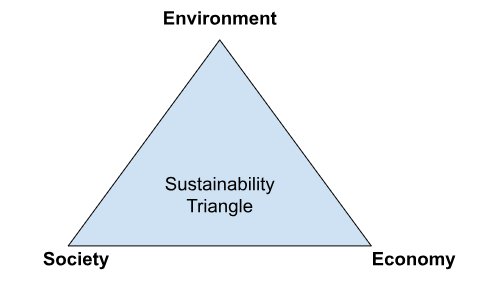
In practise,that means a country with a strong economy should remain so
- Without damaging the environment
- Or debilitating another society (or their ‘local’ environment)
Global view
If we split the total land available by the number of people on the planet, there would be 1.9 hectares available per person.
This needs to account for:
- Land to grow food
- Manufacture clothes
- Produce energy
- Cope with waste
Amongst many other requirements.
The ‘world average’ person uses 2.3 global hectares, the UK average person uses 5.5 global hectares, whilst the average person in North America uses 9.6 global hectares.
To put this into perspective, if every person on the planet lived to the same standard of living as North America, we would need two more Earth sized planets to sustain ourselves indefinitely.
But what does this have to do with Engineering Design?
Design has a strong influence on the final product. If we consider the final product costs, design accounts for just 5% of the total cost; but a 70% influence on the final product cost. As per the diagram below:
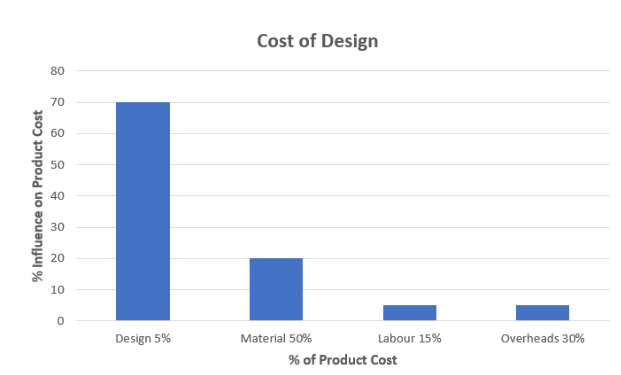
Good Engineering design is important because it accounts for just 5% of the total product cost, but has 70% influence on the overall product cost, by ensuring the most appropriate materials and manufacturing processes can be used.
But also, design influences what people want to buy.
Therefore if we consider design alongside the sustainability triangle above, we can see that:

Product Lifecycle
Environmental and social impacts occur at every stage of the product lifecycle. Take a look at the diagram below:
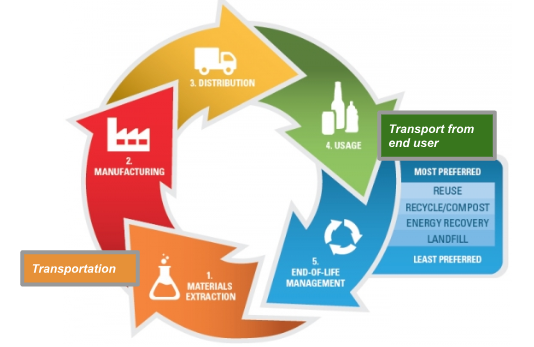
These impacts become ‘locked in’ at the design stage when decisions are made about materials, performance, power source etc. Therefore environmental and social considerations need to be included within the Design Specification.
For example:
- Environment – Product must be ‘zero emission’ device
- Social – Product components must be sourced from fair-trade organisations
Using the sustainability triangle
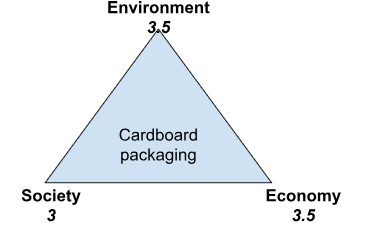
Let’s take an example of a simple everyday product such as cardboard packaging:
Where En = Environment, S = Society, Ec = Economy
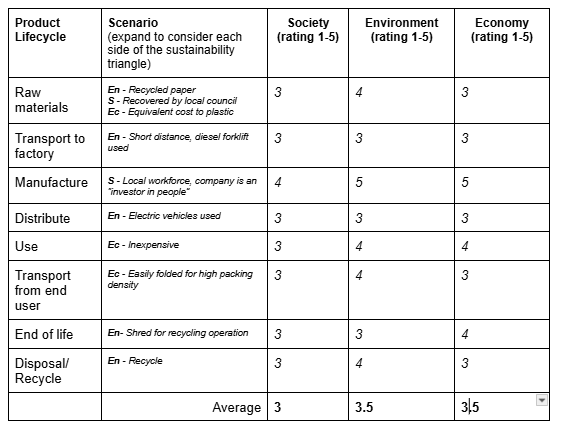
Therefore for this example, we can consider that the sustainability triangle is well balanced:
The problem arises when this sustainability triangle is not well balanced, for example, let’s imagine a product with the below sustainability score:

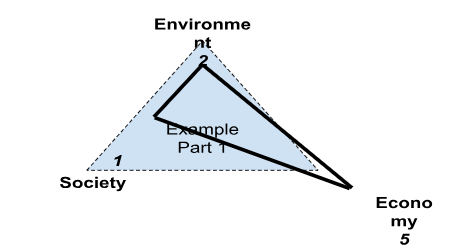
In this example, the sustainability triangle is not balanced. We can see that the ‘economy’ decisions are taking too much influence. Perhaps cost is being prioritized instead of the environment or society impacts for example.
In summary
Sustainable design means recognising that social, economic, and environmental issues are all inter-related. By considering sustainability during the design part of the lifecycle, it;
- Promotes a system focus rather than a single product focus
- Ensures the inclusion of social and ethical considerations (as well as cost alone)
- Incorporates a long-term view of the whole product lifecycle, not just the manufacturing stage
Interested in our Mechanical and Aerospace Engineering Courses?
At iLearn Engineering®, we offer a diverse range of online accredited engineering courses and qualifications to cater to different academic and career goals. Our engineering courses are available in varying credit values and levels, ranging from 40 credit Engineering Diplomas to a 360 credit International Graduate Diploma.
All Mechanical and Aerospace Engineering Courses
All Mechanical Engineering Diploma Courses are here.
All Aerospace Engineering Diploma Courses are here.
Short Courses (40 Credits)
A selection of our more popular 40 credit mechanical and aerospace engineering diplomas…
Diploma in Mechanical Engineering
Diploma in Aerospace Engineering
First Year of Undergraduate (Level 4 – 120 Credits)
Higher International Certificate in Engineering
Higher International Certificate in Mechanical Engineering
Higher International Certificate in Aerospace Engineering
First Two Years of Undergraduate (Level 5 – 240 Credits)
Higher International Diploma in Engineering
Higher International Diploma in Mechanical Engineering
Higher International Diploma in Aerospace Engineering
Degree Equivalent International Graduate Diploma (Level 6 – 360 Credits)
International Graduate Diploma in Engineering
International Graduate Diploma in Mechanical Engineering
International Graduate Diploma in Aerospace Engineering
Complete Engineering Course Catalogue (all courses)
Alternatively, you can view all our online engineering courses here.
Recent Posts
Why a Headwind Reduces Take-Off Distance: The Airspeed–Groundspeed Derivation
Why a Headwind Reduces Take-Off Distance: The Airspeed–Groundspeed Derivation Aeroplanes normally take off into wind because the wing must reach a required airspeed to produce lift, whereas the runway distance is travelled at groundspeed. A headwind contributes to the airspeed before the aircraft has covered any runway. It therefore reduces the groundspeed required at lift-off […]
How to Calculate Aircraft Take-Off Ground Run: A Flight Mechanics Tutorial
How to Calculate Aircraft Take-Off Ground Run: A Flight Mechanics Tutorial An aircraft does not become airborne simply because its engines are producing thrust. During the take-off ground run, thrust must overcome aerodynamic drag and rolling resistance. On a sloping runway, it must also overcome a component of the aircraft’s weight. This tutorial derives a […]
Types of Aircraft Drag Explained: Induced, Profile and Interference Drag
Types of Aircraft Drag Explained: Induced, Profile and Interference Drag An aircraft experiences several forms of aerodynamic drag at the same time. Some result from generating lift, some arise as air flows over the aircraft’s surfaces, and others are created when airflow around neighbouring components interacts. For a conventional aircraft in subsonic flight, total drag […]