

From Metals to Composites: How Material Choices Shape Modern Engineering
Introduction :
Engineering materials form the foundation of every product, structure and technology we rely on today. From the strength of metals and the stability of ceramics to the flexibility of polymers and the advanced performance of composites, each material offers unique properties that make it suitable for specific applications. Understanding how these materials behave, and why they are chosen, helps engineers create safer, smarter and more efficient solutions across every industry
Metals
Metals are vital in engineering due to their combination of strength, ductility, and durability, stemming from a crystalline atomic structure. These repeating patterns, or crystal structures, determine a metal’s behavior.
Most engineering metals have one of three structures:
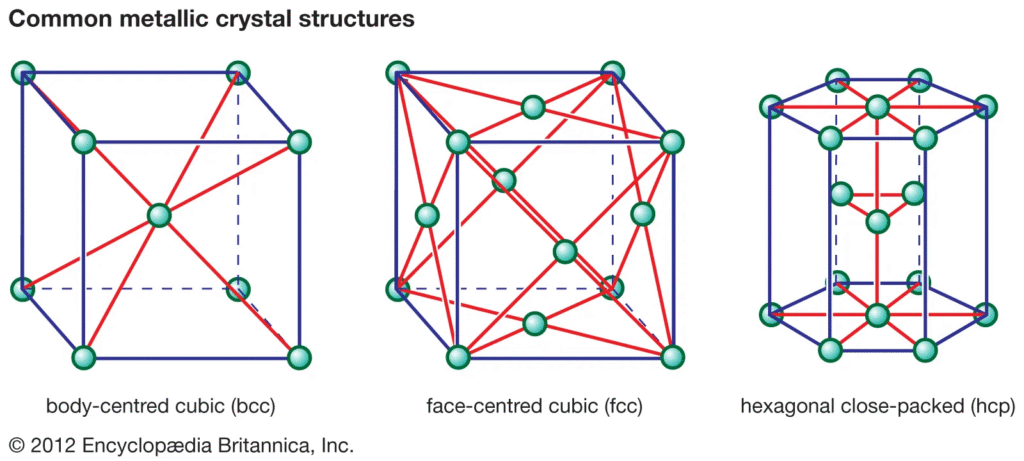
Face-centred cubic (FCC): Found in aluminum and copper, this densely packed structure allows atoms to slide easily, resulting in high ductility and formability.
Body-centred cubic (BCC): Seen in ferritic steels, this less dense arrangement offers strength but can lead to brittleness at low temperatures (ductile-brittle transition).
Hexagonal close-packed (HCP): In metals like titanium and magnesium, this structure restricts atom slippage, leading to lower room-temperature ductility but excellent specific strength, valuable for aerospace and medical use.
Internally, metals consist of grains. Grain boundaries hinder the movement of dislocations (crystal imperfections) that cause deformation. Fine grains increase strength, while coarse grains increase ductility. Engineers use heat treatments like annealing to optimize grain size.
A metal’s properties (strength, ductility, hardness, etc.) arise from its crystal structure, grain size, and defects. Examples include steel for strength, aluminum for low density, titanium for its strength-to-weight ratio, and copper for conductivity.
Selecting a metal requires balancing its internal structure, resulting properties, and the application’s demands. Understanding the atomic and grain-level structure allows engineers to choose and manipulate materials for safe and reliable performance.
Ceramics
Ceramics hold a unique place in engineering materials. Unlike flexible metals, ceramics are defined by strong, directional ionic or covalent bonds between metallic and non-metallic elements. This rigid atomic structure provides exceptional hardness, stability, and resistance to high temperatures and compressive loads, but also results in brittleness.
Their strong bonds resist ‘slip,’ the mechanism that allows metals to deform plastically. Consequently, ceramics are incredibly hard and stiff, yet fracture easily instead of bending. Most are polycrystalline, with grain boundaries often acting as weak points, while some, like glass, are amorphous.
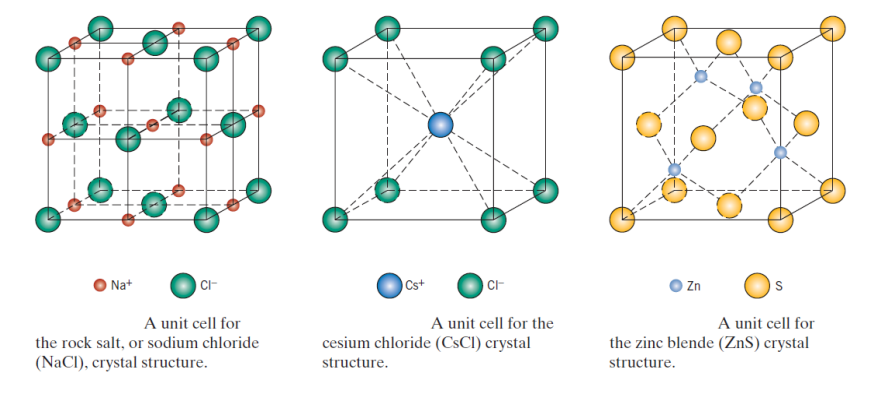
These structural traits give ceramics high hardness, wear resistance, exceptional stiffness, and the ability to withstand extreme temperatures without melting or oxidizing. They are also excellent thermal and electrical insulators due to tightly bound electrons.
Applications are broad, including cutting tools (alumina, silicon carbide), aerospace components (silicon nitride), domestic goods, and bioceramics (zirconia, hydroxyapatite) for medical implants. Advanced processing can even achieve toughness or electrical conductivity in certain ceramics.
In essence, ceramics are valued not for their ability to deform, but for their resistance, to heat, wear, chemical attack, and electrical flow, making them indispensable where stability, rigidity, and extreme environmental performance are critical.
Plastic and Polymers
Polymers and composites are distinct engineering materials based on long, flexible molecular chains (polymers) or combinations of materials (composites), offering great versatility.
Polymers
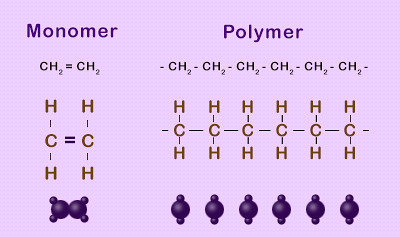
Polymers are long chain molecules formed from repeating monomers. Their structure, linear, branched, or cross-linked, determines properties like flexibility (ductile) or rigidity (thermosets). Unlike metals, they are semi-crystalline or amorphous, balancing strength/resistance with toughness/flexibility. Held by weak intermolecular forces, polymers are temperature-sensitive, exhibiting a glass transition temperature. They are lightweight, corrosion-resistant, good insulators, and easy to shape, making them ideal for packaging, piping, and specialized uses like engineering plastics (ABS, PEEK).
Composites
Composites combine two or more materials, typically a strong reinforcement (e.g., carbon or glass fibres) in a matrix (polymer, metal, or ceramic), to achieve synergistic, improved properties. Carbon-fibre composites, for instance, are lightweight, tough, and highly valued in aerospace and high-performance automotive design. Performance depends on the reinforcement’s orientation (e.g., unidirectional, woven). Beyond polymer-based types, ceramic- and metal-matrix composites offer stability at extreme temperatures or improved wear resistance, allowing for highly tailored materials.Applications and Significance
Polymers are ubiquitous, from PVC cables to ABS car interiors, prized for lightness and corrosion resistance. Composites are reserved for high-performance roles like aircraft fuselages, wind turbine blades, and Formula 1 components due to their high strength-to-weight ratio. While metals offer strength and ceramics stability, polymers and composites provide exceptional versatility, allowing engineers to precisely tailor properties to complex design requirements, continually pushing material capabilities.
Material Selection
Now that we understand the main types of material. How do you go about choosing which is the best material to use for a given part?
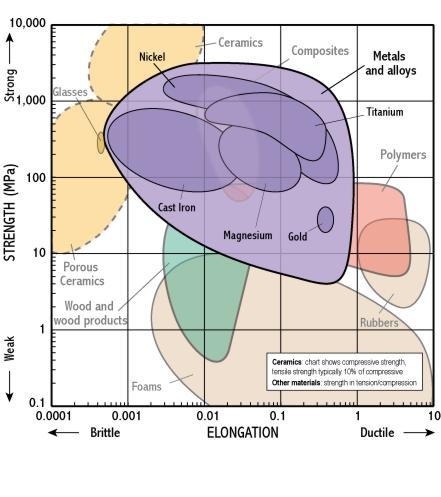
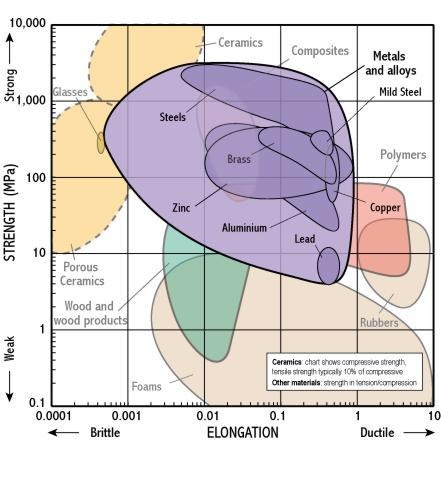
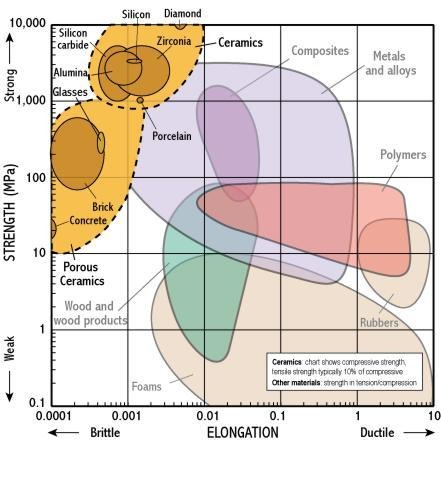
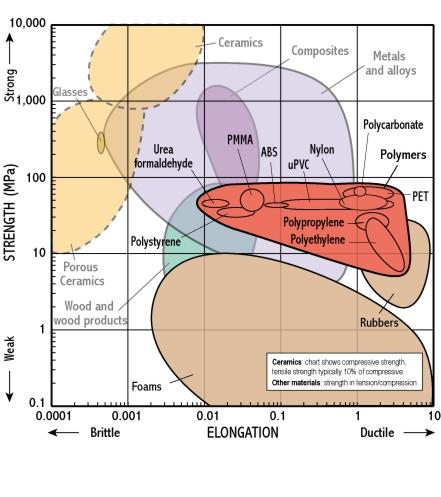
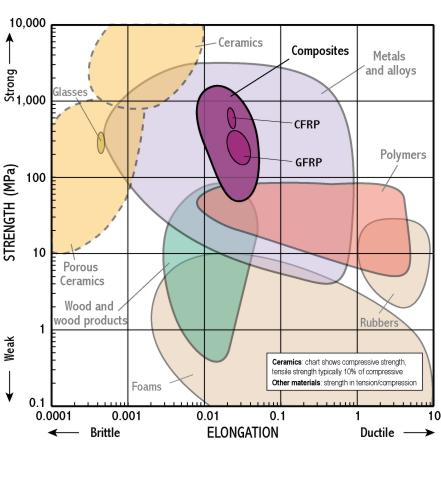
One tool that can be used is to use a Strength vs Elongation chart.
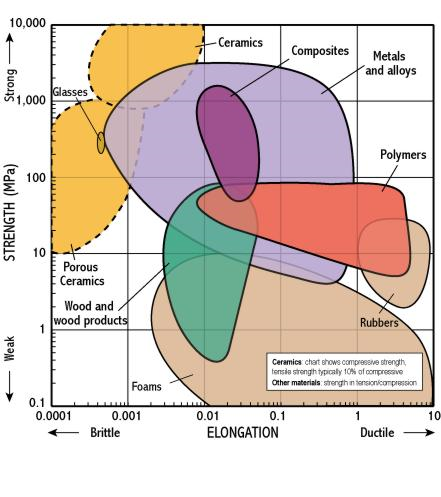
(Charts produced by the University of Cambridge).
This chart shows the different material types arranged by their Strength (vertical axis), and their Elongation (that is, their ability to stretch and deform).
Strength – A material’s strength is defined as its ability to withstand an applied load without failure or plastic (permanent) deformation.
Elongation – A material with low elongation is said to be Brittle (that it, it will fail and break rather than deform, e.g. glass), and a material with high elongation is said to be Ductile (i.e. it is possible to stretch the material before it fails, such as rubber).
By displaying the materials in this method, it gives a very useful guide to selecting a material to match the properties that we need.
We can further break this chart down into the main subcategories such as the below:
Metals and alloys
Ceramics
Polymers
Composites
Interested in our Mechanical and Aerospace Engineering Courses?
At iLearn Engineering®, we offer a diverse range of online accredited engineering courses and qualifications to cater to different academic and career goals. Our engineering courses are available in varying credit values and levels, ranging from 40 credit Engineering Diplomas to a 360 credit International Graduate Diploma.
All Mechanical and Aerospace Engineering Courses
All Mechanical Engineering Diploma Courses are here.
All Aerospace Engineering Diploma Courses are here.
Short Courses (40 Credits)
A selection of our more popular 40 credit mechanical and aerospace engineering diplomas…
Diploma in Mechanical Engineering
Diploma in Aerospace Engineering
First Year of Undergraduate (Level 4 – 120 Credits)
Higher International Certificate in Engineering
Higher International Certificate in Mechanical Engineering
Higher International Certificate in Aerospace Engineering
First Two Years of Undergraduate (Level 5 – 240 Credits)
Higher International Diploma in Engineering
Higher International Diploma in Mechanical Engineering
Higher International Diploma in Aerospace Engineering
Degree Equivalent International Graduate Diploma (Level 6 – 360 Credits)
International Graduate Diploma in Engineering
International Graduate Diploma in Mechanical Engineering
International Graduate Diploma in Aerospace Engineering
Complete Engineering Course Catalogue (all courses)
Alternatively, you can view all our online engineering courses here.
Recent Posts
Why a Headwind Reduces Take-Off Distance: The Airspeed–Groundspeed Derivation
Why a Headwind Reduces Take-Off Distance: The Airspeed–Groundspeed Derivation Aeroplanes normally take off into wind because the wing must reach a required airspeed to produce lift, whereas the runway distance is travelled at groundspeed. A headwind contributes to the airspeed before the aircraft has covered any runway. It therefore reduces the groundspeed required at lift-off […]
How to Calculate Aircraft Take-Off Ground Run: A Flight Mechanics Tutorial
How to Calculate Aircraft Take-Off Ground Run: A Flight Mechanics Tutorial An aircraft does not become airborne simply because its engines are producing thrust. During the take-off ground run, thrust must overcome aerodynamic drag and rolling resistance. On a sloping runway, it must also overcome a component of the aircraft’s weight. This tutorial derives a […]
Types of Aircraft Drag Explained: Induced, Profile and Interference Drag
Types of Aircraft Drag Explained: Induced, Profile and Interference Drag An aircraft experiences several forms of aerodynamic drag at the same time. Some result from generating lift, some arise as air flows over the aircraft’s surfaces, and others are created when airflow around neighbouring components interacts. For a conventional aircraft in subsonic flight, total drag […]