

From Slide 1 to Sign-Off: Presenting Your Design with Confidence
Presenting your design
The best and most common way to present your design is via a slideshow. A good slideshow should convey only the essential information, and be kept short and sweet. They should have a simple and professional manner to them, and not get carried away with any animations or slide transitions.
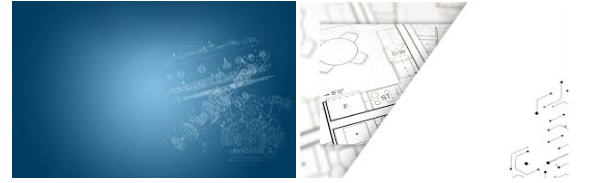
Appropriate backgrounds as the information will be the focus.

These ones are far too busy and will distract from the information.
The most powerful tool in a presentation, however, is you; when people buy your product, They are also buying you. The audience is most likely going to spend most of their time looking at you, so it’s important that you are also well presented, and dressed for the occasion.
The audience also reads your body language, and its small things such as “crossing your arms” makes you look confrontational and closed off, or slouching can show a lack of confidence, which is conveyed into a lack of confidence in your design, this can also be displayed by a monotonous tone or having your hands in your pockets.
For anyone who lacks confidence, it is amazing how much you can gain by rehearsing well for a presentation, you can practise in front of friends and family or simply just yourself. It will help the material to become well versed and you will come across as more confident.
A demonstration of the design is also welcome, whether this is a physical demonstration in the room, or a video if the design is not suited for a board room.
There is a wealth of information on the internet for how to deliver a good presentation.
Analysis of Presentation Feedback
There will always be feedback from the presentation, the most important thing about feedback is to take it on board, never dismiss it, and use it to grow and develop either the product or yourself.
If we compare it to the five-stage design process we could say the presentation is the prototype or test phase, which will feed back into the empathise, design or idea stages.
Strategies for Improvement
Remembering the five-stage design process, the testing phase can bring the project back to different steps, whether it is to completely restart at the empathise step, or the feedback redefines the problems, or maybe it is just more ideas generated for the design.
It is also important to check that the feedback provided for new ideas are feasible ones, not all feedback might be useful!
What’s important is that you document all feedback, and write it down. You can then use this to go through systematically and make any improvements to your chosen design solution if required.
Interested in our Mechanical and Aerospace Engineering Courses?
At iLearn Engineering®, we offer a diverse range of online accredited engineering courses and qualifications to cater to different academic and career goals. Our engineering courses are available in varying credit values and levels, ranging from 40 credit Engineering Diplomas to a 360 credit International Graduate Diploma.
All Mechanical and Aerospace Engineering Courses
All Mechanical Engineering Diploma Courses are here.
All Aerospace Engineering Diploma Courses are here.
Short Courses (40 Credits)
A selection of our more popular 40 credit mechanical and aerospace engineering diplomas…
Diploma in Mechanical Engineering
Diploma in Aerospace Engineering
First Year of Undergraduate (Level 4 – 120 Credits)
Higher International Certificate in Engineering
Higher International Certificate in Mechanical Engineering
Higher International Certificate in Aerospace Engineering
First Two Years of Undergraduate (Level 5 – 240 Credits)
Higher International Diploma in Engineering
Higher International Diploma in Mechanical Engineering
Higher International Diploma in Aerospace Engineering
Degree Equivalent International Graduate Diploma (Level 6 – 360 Credits)
International Graduate Diploma in Engineering
International Graduate Diploma in Mechanical Engineering
International Graduate Diploma in Aerospace Engineering
Complete Engineering Course Catalogue (all courses)
Alternatively, you can view all our online engineering courses here.
Recent Posts
Why a Headwind Reduces Take-Off Distance: The Airspeed–Groundspeed Derivation
Why a Headwind Reduces Take-Off Distance: The Airspeed–Groundspeed Derivation Aeroplanes normally take off into wind because the wing must reach a required airspeed to produce lift, whereas the runway distance is travelled at groundspeed. A headwind contributes to the airspeed before the aircraft has covered any runway. It therefore reduces the groundspeed required at lift-off […]
How to Calculate Aircraft Take-Off Ground Run: A Flight Mechanics Tutorial
How to Calculate Aircraft Take-Off Ground Run: A Flight Mechanics Tutorial An aircraft does not become airborne simply because its engines are producing thrust. During the take-off ground run, thrust must overcome aerodynamic drag and rolling resistance. On a sloping runway, it must also overcome a component of the aircraft’s weight. This tutorial derives a […]
Types of Aircraft Drag Explained: Induced, Profile and Interference Drag
Types of Aircraft Drag Explained: Induced, Profile and Interference Drag An aircraft experiences several forms of aerodynamic drag at the same time. Some result from generating lift, some arise as air flows over the aircraft’s surfaces, and others are created when airflow around neighbouring components interacts. For a conventional aircraft in subsonic flight, total drag […]