

Making Sure It Works: The Importance of Testing and Validation
Introduction :
Testing and validation are essential steps in ensuring that any engineering design or product performs exactly as intended. By rigorously checking functionality, reliability and safety, engineers can identify issues early, improve quality and build confidence in the final outcome. Whether developing a new component, system or full-scale product, testing and validation provide the evidence needed to make sure it truly works in the real world.
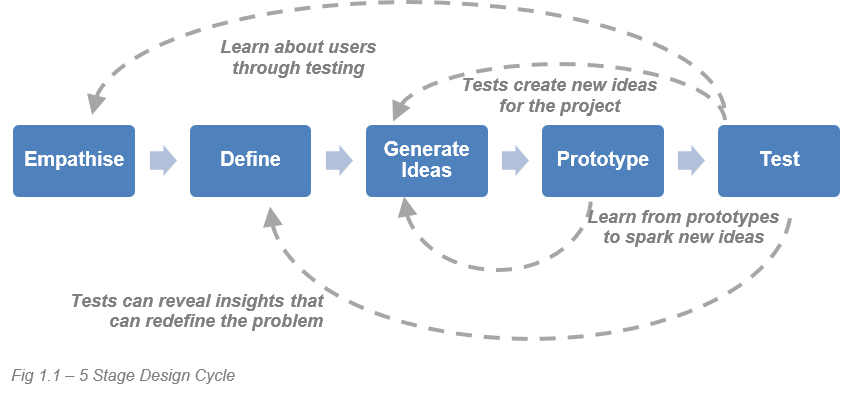
That is, testing your design to make sure it meets the requirements set out in the Design Specification.
In order to do this effectively, ISO9001 sets out two steps, Design Verification and Design Validation.
Design Verification
Verification is strictly a paper exercise. It starts with taking all the design inputs: specifications, government and industry regulations, knowledge taken from previous designs, and any other information necessary for the design to work. With these requirements in hand you compare to your design outputs: drawings, assembly instructions, test instructions, and electronic design files.
The basic question is ‘does it work on paper?’
In the comparison you are ensuring that each requirement in the inputs is accounted for in the outputs. Is each required test called out in the test instructions, including the correct pass/fail criteria for each test? Are all product acceptance criteria correct? Are all physical characteristics identified in the build instructions?
Verification is a comparison between the outputs and the inputs. Does the available evidence indicate that the design will meet the requirements? The verification could consist of calculations, simulations, prototype evaluation, tests or comparison against samples.
The output of this verification review is often recorded in a Statement of Compliance document.
This document will list every requirement for the design, identify if the design is compliant or not, and list where this compliance is proven in the documentation.
A sample line may look like this:

The obvious importance in this step is to make sure that the design has not missed addressing any requirements. If requirements are not compliant, meaning the design does not meet a requirement, now is the time to know this and either add or fix the missing requirement.
Design Validation
Validation is similar to verification, except this time you should check the designed product under conditions of actual use. This does not necessarily mean the first production unit, (although it could be). It can also be an engineering model, which some companies use to prove the first run of a complicated new design, or it can be a portion of the design which is different from a previous model, when the design is a modification of an already-proven design.
The basic question now is ‘does it work in reality?‘
Methods of validation could include simulation techniques, proto-type build and evaluation, comparison to similar proven designs, beta testing, field evaluations, etc.
Once you decide what method of validation you will use to prove your design, you fully test it to make sure that the product, as designed, will meet all the necessary requirements defined in the Design Specification.
This will often require more testing that will be used on production models. To ensure that all requirements are met, a full set of measurement and tests is done on the validation unit. In some industries this is referred to as a First Article Inspection (FAI). Depending on customer requirements this can be recorded as a standalone document, or an addition to the Statement of Compliance created in the verification step.
A sample line may look like this:
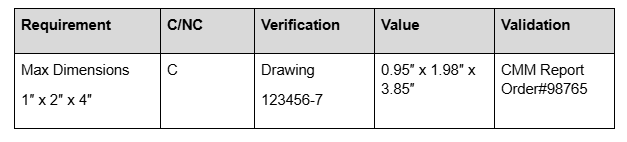
After validation, it is not likely that the full set of tests should be done on every item produced, that depends on factors such as the criticality of the requirement or manufacturing process capability (for example, some safety features might be checked on every production run). A good product validation can help decide which requirements need to be checked on every product, and which do not.
Irrespective of the methods used, the validation activity should be planned, and executed with records maintained as defined in the planning activity.
Computer Aided Design Validation
As mentioned above, sometimes it is possible to validate the test using computer methods. One of the most common methods is called Finite Element Analysis (FE Analysis).
Using FE analysis, it is possible to take the 3D model of your product (from programmes such as Autodesk Inventor) and apply representative real world loading and forces on the model to see how they bend, move and break. You will not be asked to perform these tests for this unit, but you should be aware of their use for design validation purposes.
Another common computer testing method is Computational Fluid Dynamics (CFD) – this can validate/predict how fluids will move (such as a liquid through a pipe, or airflow over an aircraft wing). However we will not cover this in any more detail in this module.
Verification vs Validation
In summary, each of these steps is important in the design process because they serve two distinct functions. Verification is a theoretical exercise designed to make sure that no requirements are missed in the design, whereas validation is a practical exercise that ensures that the product, as built, will function to meet the requirements. Together, they ensure that the product designed will satisfy the customer needs, as defined in the design specification
Interested in our Mechanical and Aerospace Engineering Courses?
At iLearn Engineering®, we offer a diverse range of online accredited engineering courses and qualifications to cater to different academic and career goals. Our engineering courses are available in varying credit values and levels, ranging from 40 credit Engineering Diplomas to a 360 credit International Graduate Diploma.
All Mechanical and Aerospace Engineering Courses
All Mechanical Engineering Diploma Courses are here.
All Aerospace Engineering Diploma Courses are here.
Short Courses (40 Credits)
A selection of our more popular 40 credit mechanical and aerospace engineering diplomas…
Diploma in Mechanical Engineering
Diploma in Aerospace Engineering
First Year of Undergraduate (Level 4 – 120 Credits)
Higher International Certificate in Engineering
Higher International Certificate in Mechanical Engineering
Higher International Certificate in Aerospace Engineering
First Two Years of Undergraduate (Level 5 – 240 Credits)
Higher International Diploma in Engineering
Higher International Diploma in Mechanical Engineering
Higher International Diploma in Aerospace Engineering
Degree Equivalent International Graduate Diploma (Level 6 – 360 Credits)
International Graduate Diploma in Engineering
International Graduate Diploma in Mechanical Engineering
International Graduate Diploma in Aerospace Engineering
Complete Engineering Course Catalogue (all courses)
Alternatively, you can view all our online engineering courses here.
Recent Posts
Why a Headwind Reduces Take-Off Distance: The Airspeed–Groundspeed Derivation
Why a Headwind Reduces Take-Off Distance: The Airspeed–Groundspeed Derivation Aeroplanes normally take off into wind because the wing must reach a required airspeed to produce lift, whereas the runway distance is travelled at groundspeed. A headwind contributes to the airspeed before the aircraft has covered any runway. It therefore reduces the groundspeed required at lift-off […]
How to Calculate Aircraft Take-Off Ground Run: A Flight Mechanics Tutorial
How to Calculate Aircraft Take-Off Ground Run: A Flight Mechanics Tutorial An aircraft does not become airborne simply because its engines are producing thrust. During the take-off ground run, thrust must overcome aerodynamic drag and rolling resistance. On a sloping runway, it must also overcome a component of the aircraft’s weight. This tutorial derives a […]
Types of Aircraft Drag Explained: Induced, Profile and Interference Drag
Types of Aircraft Drag Explained: Induced, Profile and Interference Drag An aircraft experiences several forms of aerodynamic drag at the same time. Some result from generating lift, some arise as air flows over the aircraft’s surfaces, and others are created when airflow around neighbouring components interacts. For a conventional aircraft in subsonic flight, total drag […]