

The Engineer’s Guide to Preparing a Design Specification
Introduction
A clear and well-structured design specification is the foundation of every successful engineering project. It translates customer requirements, technical considerations, and constraints into a precise, measurable set of criteria that guides the entire design process. By defining performance targets, materials, safety standards, and functional expectations, a design specification ensures that engineers, stakeholders, and clients share a common vision. This guide explores the essential steps and best practices for preparing an effective engineering design specification that supports accuracy, reduces risk, and drives project success.
Within industry there are three key documents that are used during the design process, these are:
Stakeholder Design Brief : This is a document which can be developed by the designer in consultation with the client. It should outline the main deliverables and scope of the project as well as key information such as timing and budgets.
Product Design Specification: This is the responsibility of the designer to turn the brief into a more detailed list of requirements. For example, weight limits, environmental aspects, ergonomic considerations, maintenance considerations etc.
Technical Design Report: This is the final report which should document the design process and describe the completed design. This should include final engineering drawings for manufacture.

Stakeholder Design Brief
A design brief is a written explanation, given to a designer, outlining the aims, objectives and milestones of a design project.
Fundamentally, the Design Brief is a document produced by the client. As a designer, you may support the client in the production of this document (especially if the client has a problem, but is not aware what is needed to fix it), but the overall content and requirements within the brief should be directly from the client and signed off by them.
The design brief should be concise, clear, and include key metrics such as timescales, costs, and any other restrictions. A Design Brief is a critical foundational document in any engineering or design project. It serves as a written explanation, formally presented to the designer or design team, that clearly outlines the project’s core aims, objectives, and key milestones. It acts as the primary reference point for all subsequent design work, ensuring that the final solution directly addresses the stated need.
The Client’s Responsibility:
Fundamentally, the Design Brief is a document produced by the client, the individual, team, or organization that has the problem or need and is commissioning the work. The brief is an articulation of their vision, requirements, and constraints.
The Designer’s Role in Development:
While the client owns the content, a professional designer or engineer frequently plays a crucial supportive role in the document’s production. This is especially true when a client recognizes they have a problem but is not fully aware of the optimal solution or required deliverables to fix it. The designer’s expertise is vital in helping the client to:
- Define the Problem: Moving from a general ‘pain point’ to a clear, measurable problem statement.
- Establish Measurable Objectives: Translating vague desires into concrete, quantifiable goals.
- Identify Implicit Constraints: Uncovering unstated assumptions or necessary limitations.
Key Requirements of an Effective Design Brief:
For a Design Brief to be effective, it must adhere to several principles:
- Conciseness: It should be focused and avoid unnecessary jargon or lengthy descriptive passages. Every sentence should contribute to defining the project’s parameters.
- Clarity: The language must be unambiguous, ensuring that the designer and client have a shared understanding of the goals and requirements.
- Inclusion of Key Metrics and Constraints: A comprehensive brief must explicitly detail the essential boundaries and measures of success, which typically include:
- Timescales/Deadlines: The required timeline for delivery or key project phases.
- Cost/Budget: The maximum financial resources allocated for the design and/or implementation.
- Technical Restrictions: Specific technology, materials, or interoperability standards that must be used or adhered to.
- Regulatory/Legal Restrictions: Any statutory or industry compliance requirements.
- Scope Limitations: Clearly defining what is in scope and, crucially, what is out of scope for the project.
Formal Sign-Off:
Crucially, the overall content and all core requirements within the brief must be derived directly from the client. To establish a formal agreement and prevent scope creep or disputes later in the project, the final Design Brief should be formally signed off by the client. This signature signifies their approval and commitment to the outlined plan, budget, and schedule.
Product Design Specification
As a designer, it is your role to turn the design brief into a Design Specification.
This should take the fundamental tasks from the brief and create a detailed, and quantitative list of requirements.
For example, if the design brief asks for something which can be carried around, the design specification will need to include quantitative requirement such as:
- The product should weigh no more that 12kg
- There should be two handles available for lifting
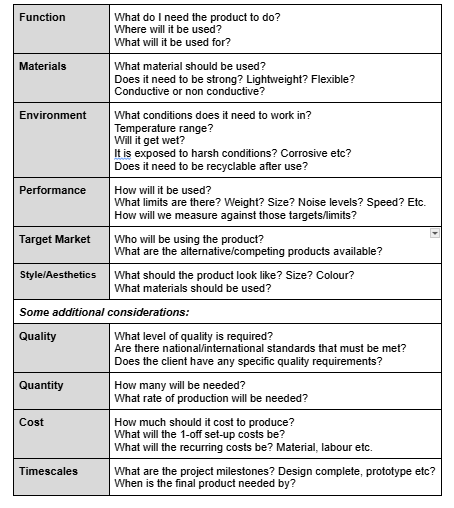
As a designer, when you receive a design brief, you should be thinking about certain key aspects of the design and asking related questions.
The key areas of consideration are:
- Function
- Materials
- Environment
- Performance
- Target Market
- Aesthetics
Technical Design Report
This document serves as the final, comprehensive record of the engineering design project. Its primary purpose is to thoroughly document the entire design process, from initial concept generation and requirements analysis through to the final, completed design solution. It should provide a clear and detailed description of the final product, system, or component, ensuring that all design decisions, analyses, and test results are meticulously recorded and justified.
Key components of the Technical Design Report must include:
- Executive Summary: A concise overview of the project, the final design, and the key findings of the report.
- Introduction and Problem Definition: A detailed description of the problem the design addresses, the project’s scope, and the initial design requirements and specifications.
- Design Process and Methodology: A systematic account of the design journey, including alternative concepts explored, selection criteria, trade-off analyses, and the iterative steps taken to arrive at the final design. Justification for the chosen solution must be a strong focus.
- Detailed Description of the Completed Design: A full technical specification of the final product, including materials used, components selected, operating principles, and system architecture. This section is supported by critical data and analysis.
- Engineering Analysis and Calculations: Presentation of all relevant calculations, simulations (e.g., Finite Element Analysis, computational fluid dynamics), and theoretical modeling used to validate the design’s performance, safety, and reliability against the initial requirements.
- Testing and Validation Results: Documentation of the testing procedures used, the data collected, and a comparison of the results against the performance criteria. Any necessary modifications made as a result of testing should also be detailed.
- Manufacturing and Assembly Information: Clear instructions and documentation related to the production of the design. Crucially, this must include a complete set of final engineering drawings (e.g., 2D orthographic projections, 3D models, assembly drawings) prepared to industry standards (e.g., ISO, ANSI) with complete dimensions, tolerances, surface finishes, and bills of materials (BOMs) suitable for immediate manufacture and assembly.
Conclusions and Recommendations: A summary of the project’s success in meeting the design brief, a discussion of any remaining limitations, and recommendations for future work or improvements.
One final point, it is important to consider the difference between ‘must haves’ and ‘would like to have’.
A ‘must have’ is essential for the successful outcome of the product. e.g. the kettle must be able to heat the water to 100C. This is different to a ‘like to have’ e.g. the kettle should boil in approximately 3minutes.
If the kettle only reaches 95C – this would be a failure.
However if the kettle takes 3 minutes 10 seconds to boil at full capacity, this may still be ok.
A good design specification should differentiate between ‘must haves’ and ‘like to haves’.
Interested in our Mechanical and Aerospace Engineering Courses?
At iLearn Engineering®, we offer a diverse range of online accredited engineering courses and qualifications to cater to different academic and career goals. Our engineering courses are available in varying credit values and levels, ranging from 40 credit Engineering Diplomas to a 360 credit International Graduate Diploma.
All Mechanical and Aerospace Engineering Courses
All Mechanical Engineering Diploma Courses are here.
All Aerospace Engineering Diploma Courses are here.
Short Courses (40 Credits)
A selection of our more popular 40 credit mechanical and aerospace engineering diplomas…
Diploma in Mechanical Engineering
Diploma in Aerospace Engineering
First Year of Undergraduate (Level 4 – 120 Credits)
Higher International Certificate in Engineering
Higher International Certificate in Mechanical Engineering
Higher International Certificate in Aerospace Engineering
First Two Years of Undergraduate (Level 5 – 240 Credits)
Higher International Diploma in Engineering
Higher International Diploma in Mechanical Engineering
Higher International Diploma in Aerospace Engineering
Degree Equivalent International Graduate Diploma (Level 6 – 360 Credits)
International Graduate Diploma in Engineering
International Graduate Diploma in Mechanical Engineering
International Graduate Diploma in Aerospace Engineering
Complete Engineering Course Catalogue (all courses)
Alternatively, you can view all our online engineering courses here.
Recent Posts
Why a Headwind Reduces Take-Off Distance: The Airspeed–Groundspeed Derivation
Why a Headwind Reduces Take-Off Distance: The Airspeed–Groundspeed Derivation Aeroplanes normally take off into wind because the wing must reach a required airspeed to produce lift, whereas the runway distance is travelled at groundspeed. A headwind contributes to the airspeed before the aircraft has covered any runway. It therefore reduces the groundspeed required at lift-off […]
How to Calculate Aircraft Take-Off Ground Run: A Flight Mechanics Tutorial
How to Calculate Aircraft Take-Off Ground Run: A Flight Mechanics Tutorial An aircraft does not become airborne simply because its engines are producing thrust. During the take-off ground run, thrust must overcome aerodynamic drag and rolling resistance. On a sloping runway, it must also overcome a component of the aircraft’s weight. This tutorial derives a […]
Types of Aircraft Drag Explained: Induced, Profile and Interference Drag
Types of Aircraft Drag Explained: Induced, Profile and Interference Drag An aircraft experiences several forms of aerodynamic drag at the same time. Some result from generating lift, some arise as air flows over the aircraft’s surfaces, and others are created when airflow around neighbouring components interacts. For a conventional aircraft in subsonic flight, total drag […]