

Managing Production vs Demand: Strategies for Balance and Efficiency
Introduction
In a perfect world, production would run like clockwork, every unit produced exactly when it’s needed, no delays, no excess, no waste. Customer demand would be predictable, and factories would operate in perfect sync.
But manufacturing doesn’t happen in a perfect world. Machines break down at the worst possible moment. A critical shipment of materials gets delayed. Suddenly, customer demand spikes without warning. These disruptions aren’t exceptions, they’re part of daily operations.
So how do manufacturers keep everything running despite this constant uncertainty?
The answer lies in buffers.
Buffers in Manufacturing: The Hidden Shock Absorbers
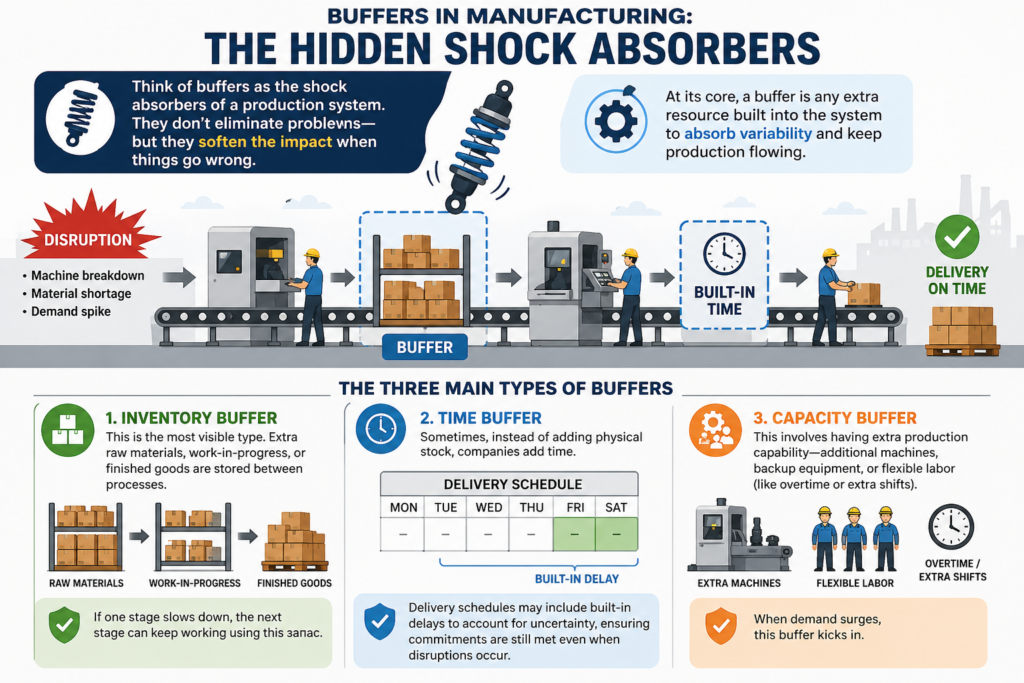
Think of buffers as the shock absorbers of a production system. They don’t eliminate problems, but they soften the impact when things go wrong.
At its core, a buffer is any extra resource built into the system to absorb variability and keep production flowing.
The Three Main Types of Buffers
1. Inventory Buffer
This is the most visible type. Extra raw materials, work-in-progress, or finished goods are stored between processes.
If one stage slows down, the next stage can keep working using this запас.
2. Time Buffer
Sometimes, instead of adding physical stock, companies add time. Delivery schedules may include built-in delays to account for uncertainty, ensuring commitments are still met even when disruptions occur.
3. Capacity Buffer
This involves having extra production capability, additional machines, backup equipment, or flexible labor (like overtime or extra shifts). When demand surges, this buffer kicks in.
Why Buffers Matter (and Their Trade-offs)
Buffers play a critical role in keeping operations stable. They help:
- Prevent costly production stoppages
- Protect delivery deadlines
- Smooth out variability in the system
- Improve overall reliability
However, buffers come at a cost. Too much inventory ties up capital and increases storage expenses. Excess capacity can sit idle. Too much time buffer may slow responsiveness.
The real challenge isn’t whether to use buffers, it’s how much is enough.
Speaking the Same Language: Key Manufacturing Terminology
Beyond buffers, another often overlooked challenge in production systems is communication. Manufacturing involves multiple teams, engineering, operations, supply chain, and each must stay aligned. That’s where a shared language becomes essential.
Here are some core terms you’ll encounter:
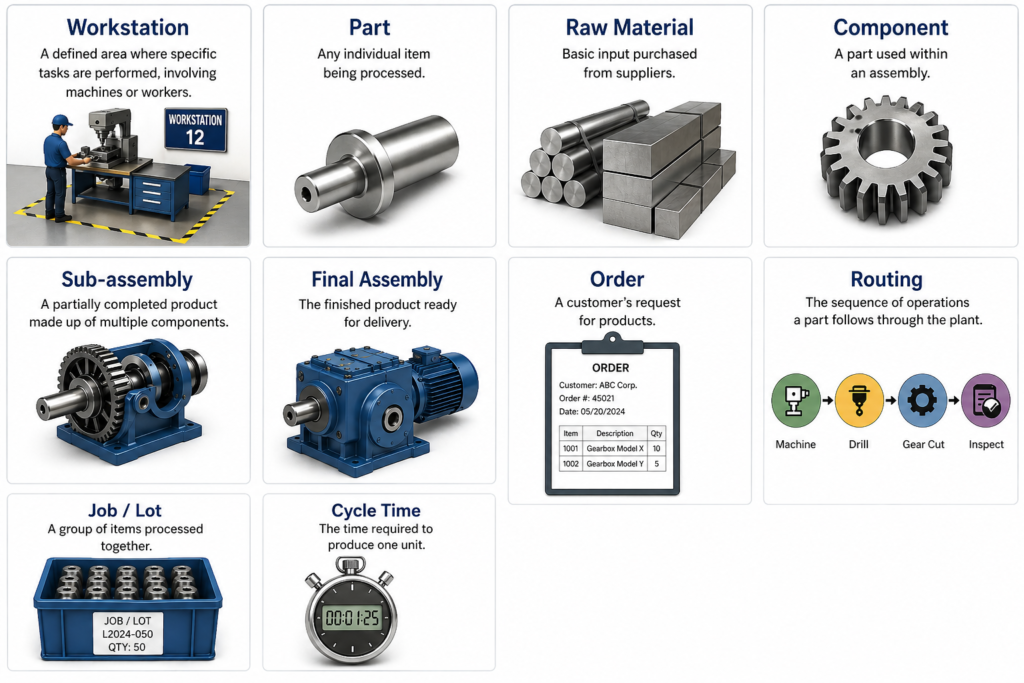
- Workstation: A defined area where specific tasks are performed, involving machines or workers
- Part: Any individual item being processed
- Raw Material: Basic input purchased from suppliers
- Component: A part used within an assembly
- Sub-assembly: A partially completed product made up of multiple components
- Final Assembly: The finished product ready for delivery
- Order: A customer’s request for products
- Routing: The sequence of operations a part follows through the plant
- Job / Lot: A group of items processed together
- Cycle Time: The time required to produce one unit
Building a Common Language for Better Performance
When everyone in the organization uses the same terminology, something powerful happens. Misunderstandings decrease. Decisions become faster. Teams collaborate more effectively across departments.
In complex production environments, clarity isn’t just helpful, it’s essential.
Managing production against unpredictable demand is less about eliminating uncertainty and more about designing systems that can handle it.
Buffers provide resilience. Clear terminology provides alignment. Together, they form the foundation of a production system that doesn’t just survive variability, but performs despite it.
Interested in our Industrial & Manufacturing Engineering Courses?
At iLearn Engineering®, we offer a diverse range of online accredited Industrial, Manufacturing and Mechanical Engineering courses and qualifications to cater to different academic and career goals. Our industrial courses are available in varying credit values and levels, ranging from 40 credit Engineering Diplomas to a Bachelor’s equivalent 360 credit International Graduate Diploma.
All Industrial / Manufacturing Engineering Courses
All Industrial / Manufacturing Engineering Diploma Courses can be seen here.
All Mechanical Engineering Diploma Courses can be seen here.
Short Courses for Industrial Engineering (40 Credits)
- Diploma in Manufacturing
- Diploma in Composites, Smart Materials & Nanotechnology
- Diploma in Lean Manufacturing
- Diploma in Mechanical Technology
- Diploma in Electrical Technology
- Diploma in Material Science
First Year of Undergraduate (Level 4 – 120 Credits)
Higher International Certificate in Industrial Engineering
Higher International Certificate in Mechanical Engineering
Years One and Two of Undergraduate (Level 5 – 240 Credits)
Higher International Diploma in Industrial Engineering
Higher International Diploma in Mechanical Engineering
Degree Equivalent International Graduate Diplomas in Engineering Management and Mechanical Engineering (Level 6 – 360 Credits)
International Graduate Diploma in Engineering Management (Level 6) [120 Credit Top Up]
International Graduate Diploma in Mechanical Engineering (Level 6) [120 Credit Top Up]
Complete Engineering Course Catalogue (all courses)
Alternatively, you can view all our online engineering courses here.
Get started today
Explore our range of Industrial and Manufacturing Engineering courses
Recent Posts
Types of Aircraft Drag Explained: Induced, Profile and Interference Drag
Types of Aircraft Drag Explained: Induced, Profile and Interference Drag An aircraft experiences several forms of aerodynamic drag at the same time. Some result from generating lift, some arise as air flows over the aircraft’s surfaces, and others are created when airflow around neighbouring components interacts. For a conventional aircraft in subsonic flight, total drag […]
Induced Drag Explained: Why Flying Slower Can Increase Drag
Induced Drag Explained: Why Flying Slower Can Increase Drag Why can an aircraft experience more drag when it flies more slowly? We usually associate greater speed with greater air resistance, but a wing must also generate enough lift to support the aircraft. Induced drag is the drag associated with producing lift on a finite-span wing. […]
Laminar vs Turbulent Boundary Layers: Why Airflow Separates from Aircraft Wings
Laminar vs Turbulent Boundary Layers: Why Airflow Separates from Aircraft Wings Airflow around an aircraft wing is often shown as smooth streamlines passing neatly over the aerofoil. In reality, the thin layer of air immediately next to the wing surface behaves very differently from the undisturbed airflow further away. This region is called the boundary […]