

How can we select engineering materials?
In our previous article, we looked at elastic and magnetic hysteresis. In this article, we’re going to look at how we can select engineering materials. In other articles, we have previously looked at the different materials and their properties. However, it’s important that engineers understand how we can go about picking the correct material for our engineering application.
Material selection charts
These charts are a graphical way of representing material data. As the majority of mechanical properties range of several orders of magnitude, the charts are produced with a logarithmic scale.
The image below shows an example chart for Young’s modulus versus density for certain material families, such as ceramics, wood, metals and so on:
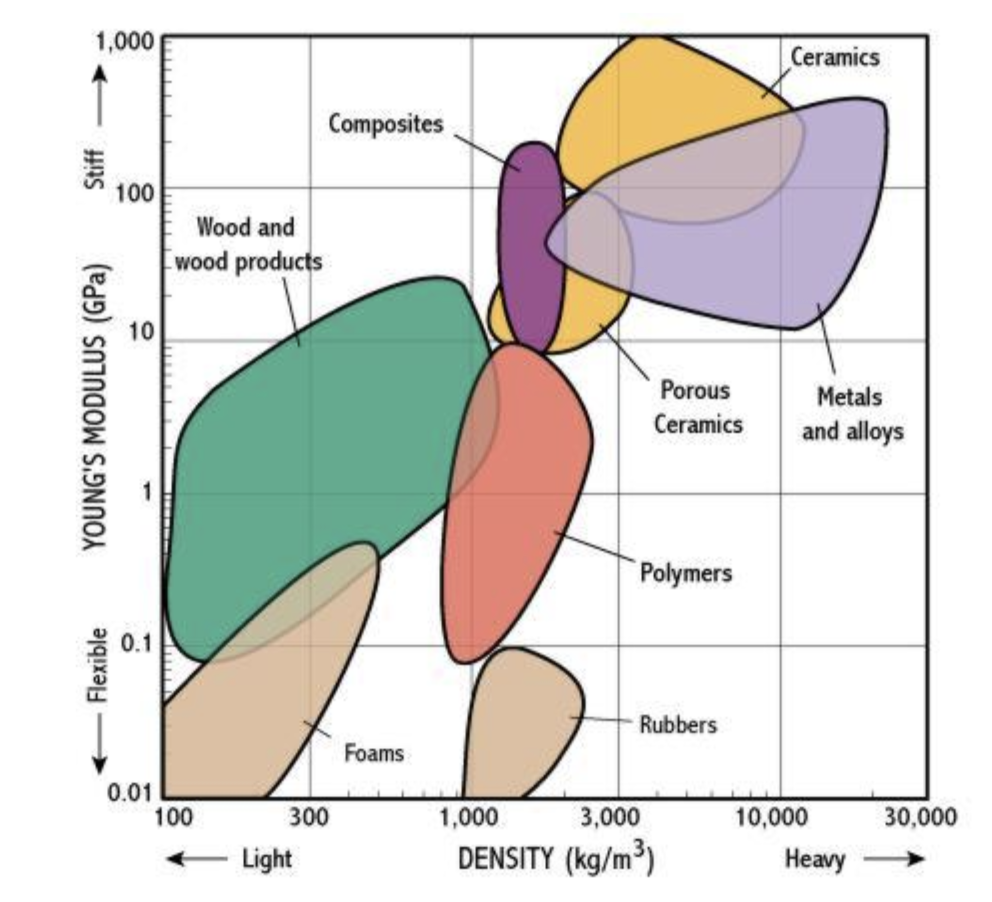
On the Y-axis, you can see that the values for Young’s modulus are given in GPa. With a logarithmic scale being used, a wide range of values from 0.01GPa (10MPa), i.e. very flexible materials, all the way through to 1000GPa (very stiff materials) can easily be shown.
On the x-axis we have material density, going from light materials through to heavy materials. Each coloured ‘bubble’ represents a whole material family, so we can quickly see how different materials types measure. For example, it is no surprise to see that wood and wood products are generally lower density (and therefore weight) than metals and alloys.
Each ‘bubble’ can then be further split down to show the individual material properties within that classification. For example, the Young’s modulus vs density chart is now shown with metals and polymers expanded into more detail:
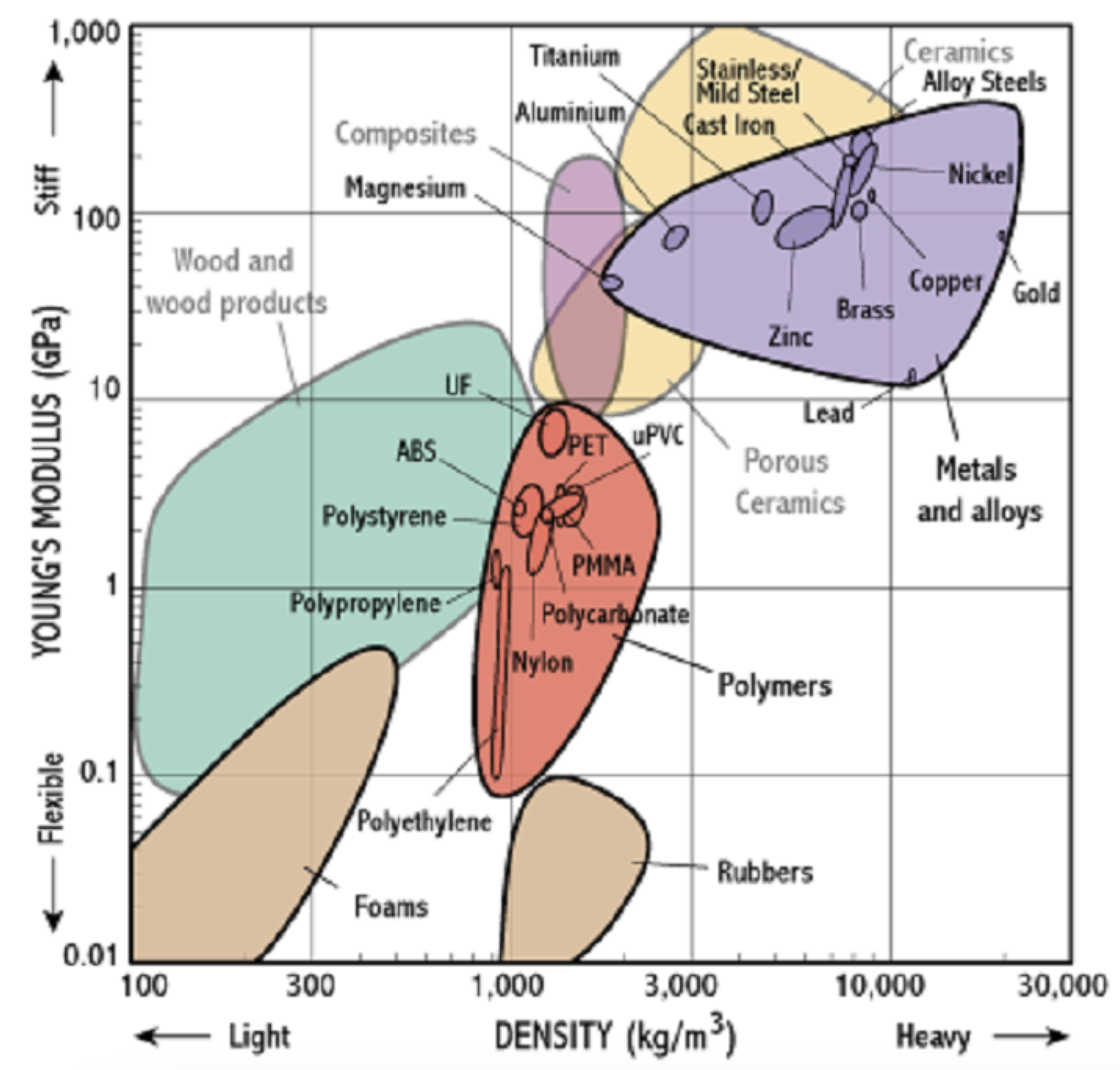
It’s worth noting how each specific material takes up a much smaller ‘bubble’, so now the chart starts to become much more useful for material selection purposes, and engineers can dive a lot deeper into selecting a specific material, for example copper rather than a generic ‘metal’.
Engineering designers have a challenging task in choosing the appropriate material for any given product. It is common for them to have to consider many competing objectives and constraints at once – light and stiff, strong and cheap, tough and recyclable (or maybe all of these at once!). Material selection in design is therefore a matter of assessing trade-offs between several competing requirements, and the material selection charts help to visualise these trade-offs, making it a lot easier for engineering designers to visualise how various materials might affect their design. This makes it a lot easier to select an appropriate material overall.
Keep an eye out for our next articles looking at basic electrical parameters and how we calculate them.
Interested in our courses?
You can read more about our selection of accredited online mechanical and industrial engineering courses here.
Check out individual courses pages below:
Higher International Diploma in Mechanical Engineering
Higher International Certificate in Mechanical Engineering
Diploma in Mechanical Engineering
Diploma in Mechanical Technology
Higher International Diploma in Industrial Engineering
Higher International Certificate in Industrial Engineering
Diploma in Engineering Management
Alternatively, you can view all our online engineering courses here.
Recent Posts
Why a Headwind Reduces Take-Off Distance: The Airspeed–Groundspeed Derivation
Why a Headwind Reduces Take-Off Distance: The Airspeed–Groundspeed Derivation Aeroplanes normally take off into wind because the wing must reach a required airspeed to produce lift, whereas the runway distance is travelled at groundspeed. A headwind contributes to the airspeed before the aircraft has covered any runway. It therefore reduces the groundspeed required at lift-off […]
How to Calculate Aircraft Take-Off Ground Run: A Flight Mechanics Tutorial
How to Calculate Aircraft Take-Off Ground Run: A Flight Mechanics Tutorial An aircraft does not become airborne simply because its engines are producing thrust. During the take-off ground run, thrust must overcome aerodynamic drag and rolling resistance. On a sloping runway, it must also overcome a component of the aircraft’s weight. This tutorial derives a […]
Types of Aircraft Drag Explained: Induced, Profile and Interference Drag
Types of Aircraft Drag Explained: Induced, Profile and Interference Drag An aircraft experiences several forms of aerodynamic drag at the same time. Some result from generating lift, some arise as air flows over the aircraft’s surfaces, and others are created when airflow around neighbouring components interacts. For a conventional aircraft in subsonic flight, total drag […]