

Common Lubrication Mistakes That Damage Machinery
Lubrication is often treated as a routine task: identify a grease point, operate the grease gun and move on. In reality, lubrication is a controlled engineering activity. The correct product applied in the wrong quantity, at the wrong time or through contaminated equipment can still damage a machine.
The most common lubrication mistakes are using the wrong lubricant, applying too much or too little, mixing incompatible products, allowing dirt or water to enter the system, using unsuitable relubrication intervals and failing to control storage, dispensing and maintenance records. These errors can increase friction, heat, wear, leakage and corrosion, eventually contributing to premature component failure.
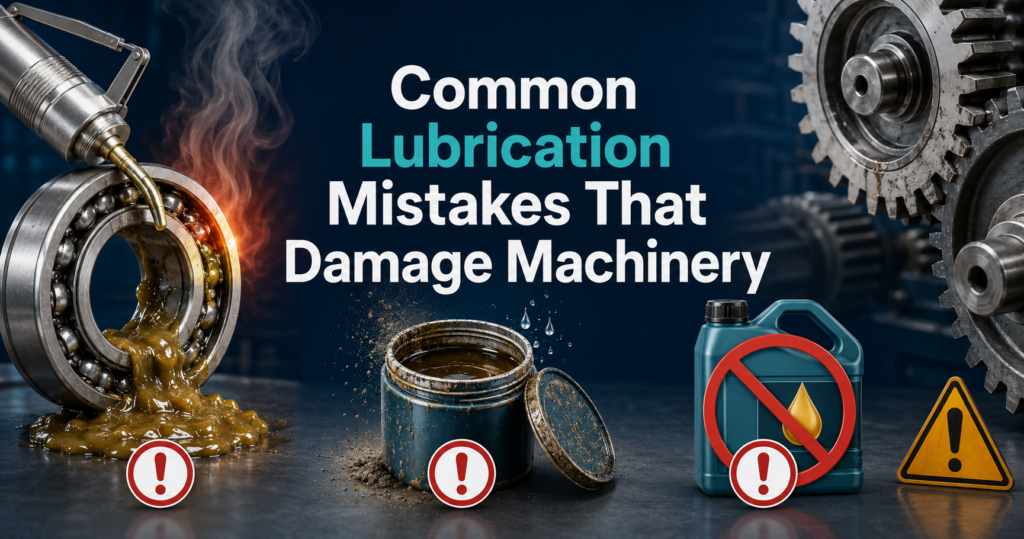
Understanding how these mistakes cause harm helps maintenance teams replace habit and guesswork with repeatable, evidence-based practice.
Why does poor lubrication damage machinery?
Moving machine surfaces are never perfectly smooth. A suitable lubricant forms a separating film, reduces friction, carries heat away from some contacts and can help protect surfaces against corrosion and contamination.
Lubrication performance depends on more than simply having oil or grease present. The lubricant must:
- Suit the component and operating conditions
- Have the required viscosity and performance characteristics
- Reach the contact in the correct quantity
- Remain sufficiently clean and chemically stable
- Be replenished or replaced at an appropriate interval
Failure in any one of these areas can weaken the lubricating film or prevent the lubricant reaching the surfaces it is intended to protect.
For a broader explanation of these functions, read iLearn Engineering’s guide to lubricants and lubrication systems in machinery.
Mistake 1: using the wrong lubricant
Two lubricants can look similar while having very different properties. Choosing by colour, texture, brand familiarity or whatever happens to be available is not a reliable selection method.
The equipment specification may define:
- Oil viscosity or International Organization for Standardization Viscosity Grade (ISO VG)
- Grease consistency, commonly expressed using a National Lubricating Grease Institute (NLGI) grade
- Base-oil type
- Thickener type for grease
- Anti-wear or extreme-pressure performance
- Resistance to water, oxidation or high temperatures
- Compatibility with seals and other materials
- Required manufacturer approvals
The wrong viscosity can create an oil film that is too thin at operating temperature or a lubricant that is too resistant to flow during start-up. The wrong additive system may also be unsuitable for the materials, loads or environment involved.
Lubricant form matters as well. Oil, grease and dry lubricants provide different methods of delivery and retention. Where that initial choice is unclear, use iLearn Engineering’s comparison of oil, grease and dry lubricants.
Better practice: Verify the machine manual, lubrication chart, component-manufacturer guidance and approved product list before selecting or substituting a lubricant. A broadly similar label is not proof of equivalence.
Mistake 2: applying too little lubricant
Under-lubrication can occur because too little product is applied, the interval is too long, the lubricant leaks away or the delivery path is restricted.
Possible consequences include:
- Inadequate film thickness
- Increased metal-to-metal interaction
- Rising friction and temperature
- Accelerated wear
- Noise or vibration
- Seizure or premature failure in severe cases
The presence of grease in a housing does not prove that fresh base oil is reaching the rolling contact. Hardened grease, blocked passages, low-temperature flow resistance or a damaged lubrication line can leave a component starved even when the maintenance record shows that lubrication was completed.
SKF explains that unsuitable base-oil viscosity at low temperatures can restrict the release and movement of oil within grease, increasing the risk of starvation in a rolling bearing.[1]
Better practice: Specify both quantity and interval. Check that the delivery route is open, inspect for leakage and use equipment condition—not merely completion of a task—as evidence that the lubrication process is working.
Mistake 3: applying too much grease
If too little lubricant is harmful, it is tempting to assume that extra grease provides extra protection. That assumption can be costly.
In a rolling bearing, excessive grease can be churned by the rotating elements. Churning increases resistance and temperature. High pressure from a grease gun can also disturb seals or force grease where it should not go. Excess lubricant outside the component can collect dirt and inhibit heat dissipation.
SKF advises that excessive grease can increase friction and cause bearing temperature to rise.[2] Mobil also notes that excess grease and dirt on external surfaces act as insulation and reduce heat dissipation.[3]
Common causes of overgreasing include:
- Pumping until grease visibly escapes
- Assuming every grease gun delivers the same amount per stroke
- Failing to account for the bearing and housing dimensions
- Lubricating too frequently
- Adding grease without allowing the correct purge route
- Continuing to lubricate automatically while equipment is stopped
Better practice: Treat a grease gun as a measured-delivery tool. Determine its output per stroke, follow the specified quantity and interval, and use a manufacturer calculation tool where appropriate.
Timken’s engineering calculator, for example, separates grease selection, initial fill and relubrication quantity because these are distinct decisions.[4]
Mistake 4: mixing incompatible lubricants
Topping up a machine with a different product may appear harmless when both containers say “grease” or show the same viscosity grade. Compatibility cannot be established from appearance or one grade number.
Different grease thickeners or additive systems may interact. A mixture can soften, harden, separate or lose the properties required by the application. Oil mixtures may also compromise performance, approvals or additive balance even when the base fluids appear miscible.
Mobil warns that mixing greases can lead to ineffective lubrication and damage. It also explains that incompatibility may cause excessive hardening or softening of the mixture.[3]
Better practice: Do not mix products unless compatibility and application suitability have been confirmed. During a changeover, follow an approved flushing or purging procedure and identify every dispensing container and lubrication point clearly.
Mistake 5: allowing contamination into the lubricant
Lubricants can become contaminated before they reach the machine or while they are in service.
Common contaminants include:
- Dust and hard particles
- Water or process fluid
- Wear debris
- Fibres from unsuitable cleaning materials
- An incorrect lubricant
- Air introduced through leaks or poor reservoir conditions
Hard particles can enter loaded contacts and contribute to indentation or abrasive wear. Water can promote corrosion, affect additives and alter lubrication behaviour. Aeration can disrupt oil delivery and encourage foaming.
Milky or hazy oil can indicate water contamination or aeration, although appearance alone is not a complete diagnosis. Mobil advises inspecting the lubricant and equipment before continuing to operate a gearbox with milky oil because water or entrained air may be involved.[5]
Common contamination routes include open containers, dirty funnels, shared transfer equipment, damaged breathers, unsealed fill points and pressure washing near vulnerable seals.
Better practice: Use sealed, clean and dedicated transfer containers; clean the area around a fill or grease point before opening it; maintain seals, breathers and filters; and investigate any abnormal colour, odour, foam, sediment or laboratory result.
Mistake 6: setting intervals by habit alone
“Every Friday” is easy to remember, but a calendar interval is not automatically suitable for every machine.
Lubricant life and replenishment needs depend on factors such as:
- Operating hours
- Speed and load
- Temperature
- Shock and vibration
- Exposure to dust, water or chemicals
- Lubricant type and quantity
- Component design
- The effectiveness of seals and delivery systems
An interval that is too long can permit starvation or degradation. An interval that is too short can cause overgreasing, waste and unnecessary disturbance of a clean system.
Mobil recommends beginning with equipment-builder maintenance schedules and using lubricant analysis where appropriate to assess whether oil remains suitable for service.[3]
Better practice: Establish a documented baseline from manufacturer guidance, then refine it using operating hours, environment, inspection findings and condition-monitoring evidence. Do not extend an interval simply because the oil still looks clean.
Mistake 7: storing and dispensing lubricants poorly
A correctly specified lubricant can be compromised before it reaches the machine. Open lids, damaged seals, outdoor exposure, temperature cycling and dirty dispensing equipment all create opportunities for deterioration or contamination.
Mobil recommends clean, dry storage protected from dust, humidity and water, with labels kept visible to reduce the risk of misapplication.[6]
Poor stock control creates additional risks. An unidentified half-full container may be used in the wrong machine, while obsolete stock can remain beyond its recommended shelf-life controls.
Better practice:
- Retain products in sealed, labelled containers
- Provide a clean, dry and controlled storage area
- Segregate incompatible or special-purpose lubricants
- Use dedicated, labelled transfer equipment
- Record delivery and opening dates
- Rotate stock appropriately
- Keep new lubricant separate from waste oil and used equipment
Mistake 8: neglecting the lubrication system
Maintenance teams sometimes focus on the lubricant while overlooking the equipment that stores, filters and delivers it.
A suitable oil cannot protect a bearing if a blocked line prevents delivery. A correctly selected grease cannot perform as intended if the automatic lubricator is empty, incorrectly adjusted or disconnected.
Items requiring inspection can include:
- Pumps and automatic lubricators
- Grease nipples and connectors
- Pipes, hoses and distribution blocks
- Filters, strainers and breathers
- Reservoir level indicators
- Seals, drains and sample points
- Alarms, flow indicators and pressure readings
A high pressure reading may indicate resistance or blockage rather than successful delivery. Likewise, a low reservoir level may result from leakage rather than normal consumption.
Better practice: Include lubrication hardware within preventive maintenance inspections and function-test critical delivery points.
iLearn Engineering’s overview of total productive maintenance principles provides wider context for integrating routine care with equipment reliability.
Mistake 9: failing to clean before relubrication
Attaching a grease gun to a dirty nipple can inject external contamination with the new grease. Opening a reservoir without cleaning the surrounding area can have the same effect.
Cleaning also matters when changing products. Residual lubricant may be incompatible with the replacement or may contain the very contamination that prompted the change.
Better practice: Clean fill points, grease fittings, tools and surrounding surfaces before opening the system. Use lint-free materials suited to the task, replace damaged caps and follow the approved flushing or purging method during a product change.
Mistake 10: treating the symptom instead of the cause
When a bearing becomes noisy or hot, adding lubricant is a common first reaction. That response can make the problem worse if the component is already overgreased, misaligned, overloaded or mechanically damaged.
Lubrication symptoms are not always caused by the lubricant. High temperatures can also result from excessive load, incorrect clearance, restricted cooling or misalignment. Leakage may indicate a damaged seal, excessive fill level, blocked breather or unsuitable viscosity.
Better practice: Compare the observation with a known operating baseline. Check load, speed, alignment, temperature, lubricant condition, quantity and delivery before deciding on corrective action.
For persistent or repeated failures, use a structured method such as root cause analysis rather than repeatedly replacing components.
Warning signs of a lubrication problem
The following signs justify investigation, but none identifies a single cause by itself.
| Observation | Possible lubrication-related causes | Initial checks |
|---|---|---|
| Rising temperature | Excess grease, insufficient supply, wrong viscosity or degraded lubricant | Quantity, grade, flow, operating load and temperature trend |
| Unusual noise or vibration | Starvation, contamination, surface damage or unsuitable lubricant | Delivery route, lubricant condition and component condition |
| Milky or cloudy oil | Water contamination or aeration | Water source, seals, breathers, suction leaks and laboratory analysis |
| Foaming | Air ingress, contamination, incorrect level or unsuitable product | Oil level, return flow, suction-side leaks and product specification |
| Grease leakage | Overfilling, seal damage, high temperature or incompatible grease | Applied quantity, purge path, seal condition and grease identity |
| Darkened oil or deposits | Oxidation, excessive temperature, contamination or extended service | Temperature history, interval, filtration and oil analysis |
| Repeated component failure | Incorrect selection, quantity, interval, contamination or unrelated mechanical fault | Full lubrication record and structured root cause analysis |
Stop or isolate equipment where continued operation could create an unsafe condition or severe secondary damage. Follow the site’s safety procedures and equipment-manufacturer instructions.
The CLEAR lubrication checklist
The CLEAR checklist is an iLearn Engineering framework for organising routine lubrication work. It is not an industry standard and does not replace equipment-specific instructions.
- C — Confirm the product: Verify lubricant identity, specification, compatibility and approval before use.
- L — Load the correct quantity: Use a measured amount and the specified application method.
- E — Exclude contamination: Keep storage, transfer tools, fittings and fill points clean and sealed.
- A — Assess the condition: Observe temperature, noise, vibration, leakage and lubricant condition before and after the task.
- R — Record the work: Log the product, amount, date, operating hours, observations and any corrective action.
This framework turns lubrication from an isolated maintenance action into a traceable process. Records make it easier to recognise abnormal consumption, missed points, repeat failures and unsuitable intervals.
Develop your understanding of machinery maintenance
Effective lubrication supports the wider study of bearings, gears, seals, hydraulic systems, power transmission, preventive maintenance and fault investigation.
The Diploma in Mechanical Technology is a focused 40-credit Level 4 route covering engineering science and machines and systems.
For broader study, the Higher International Certificate in Mechanical Engineering provides a 120-credit Level 4 foundation.
The Higher International Diploma in Mechanical Engineering comprises 240 credits in total and incorporates Level 4.
The International Graduate Diploma in Mechanical Engineering comprises 360 credits in total and incorporates Level 5.
Compare these mechanical engineering pathways and select the depth of study that best supports your professional-development objectives.
Frequently asked questions
Can too much grease damage a bearing?
Yes. Excess grease can increase churning, friction and temperature. It may also place pressure on seals or prevent efficient heat dissipation. Use the specified fill or replenishment quantity rather than pumping until grease escapes.
What happens when a machine is under-lubricated?
The separating film can become inadequate, increasing friction, heat and surface interaction. Continued starvation may contribute to accelerated wear or component failure.
Can two greases with the same NLGI grade be mixed?
Not automatically. NLGI grade describes consistency, not complete chemical compatibility or application suitability. Thickener, base oil and additive interactions must be checked before mixing.
How often should machinery be lubricated?
There is no universal interval. Begin with equipment or component-manufacturer guidance and consider operating hours, speed, load, temperature, environment, lubricant type and condition-monitoring evidence.
Does new oil need to be kept clean?
Yes. New oil can collect particles or moisture during storage and transfer. Use sealed containers, clean dedicated equipment and appropriate filtration or cleanliness controls for the system.
Why does gearbox oil look milky?
A milky or hazy appearance can indicate water contamination or entrained air. The equipment, seals, breathers, oil level and lubricant condition should be inspected before continued operation.
Should grease be added when a bearing becomes hot?
Not until the cause has been investigated. A hot bearing may be under-lubricated, but it may also contain too much grease or have an unrelated load, alignment, clearance or damage problem.
What information belongs in a lubrication record?
Record the machine and lubrication point, lubricant identity, amount, date, operating hours, person completing the task, observations and any follow-up action. The record should allow abnormal trends and repeat problems to be identified.
References
[1] SKF: Lubrication of bearings at low temperatures
[2] SKF: Bearings that slide and roll
[3] Mobil: Industrial lubrication and storage FAQs
[4] Timken Engineering: Grease Lubrication Calculator
[5] Mobil: Industrial gear oil looks milky or hazy
[6] Mobil: How to properly store oil drums indoors
Interested in our engineering courses?
We have over 70 courses across all major engineering disciplines, including, mechanical, electrical and electronic, civil, aerospace, industrial, computer and general engineering. Visit our course catalogue for a complete list of fully accredited engineering programmes.
A small selection of short Engineering courses …
Diploma in Mechanical Technology
Diploma in Mechanical Engineering
Level 6 Engineering Courses
International Graduate Diploma in Mechanical Engineering
Level 5 Engineering Courses
Higher International Diploma in Industrial Engineering
Higher International Diploma in Mechanical Engineering
Level 4 Engineering Courses
Higher International Certificate in Industrial Engineering
Higher International Certificate in Mechanical Engineering
View Engineering Courses
Explore our UK-accredited engineering courses. 100% Online with no schedules, no deadlines and no exams.
Recent Posts
Types of Aircraft Drag Explained: Induced, Profile and Interference Drag
Types of Aircraft Drag Explained: Induced, Profile and Interference Drag An aircraft experiences several forms of aerodynamic drag at the same time. Some result from generating lift, some arise as air flows over the aircraft’s surfaces, and others are created when airflow around neighbouring components interacts. For a conventional aircraft in subsonic flight, total drag […]
Induced Drag Explained: Why Flying Slower Can Increase Drag
Induced Drag Explained: Why Flying Slower Can Increase Drag Why can an aircraft experience more drag when it flies more slowly? We usually associate greater speed with greater air resistance, but a wing must also generate enough lift to support the aircraft. Induced drag is the drag associated with producing lift on a finite-span wing. […]
Laminar vs Turbulent Boundary Layers: Why Airflow Separates from Aircraft Wings
Laminar vs Turbulent Boundary Layers: Why Airflow Separates from Aircraft Wings Airflow around an aircraft wing is often shown as smooth streamlines passing neatly over the aerofoil. In reality, the thin layer of air immediately next to the wing surface behaves very differently from the undisturbed airflow further away. This region is called the boundary […]