

What Is a Diploma in Engineering? Courses, Levels and Career Routes Explained
Introduction
Engineering shapes the world around us, from the buildings we live in to the technology we use every day. But for many aspiring engineers, the biggest question is not whether to pursue engineering, but how to start. Traditional university degrees are not always accessible or practical for everyone, and this is where a Diploma in Engineering offers a powerful and flexible alternative.
Rather than committing immediately to a full degree, an engineering diploma allows you to build your knowledge step by step, gaining recognised qualifications along the way while keeping your options open.
Understanding the Engineering Diploma Pathway
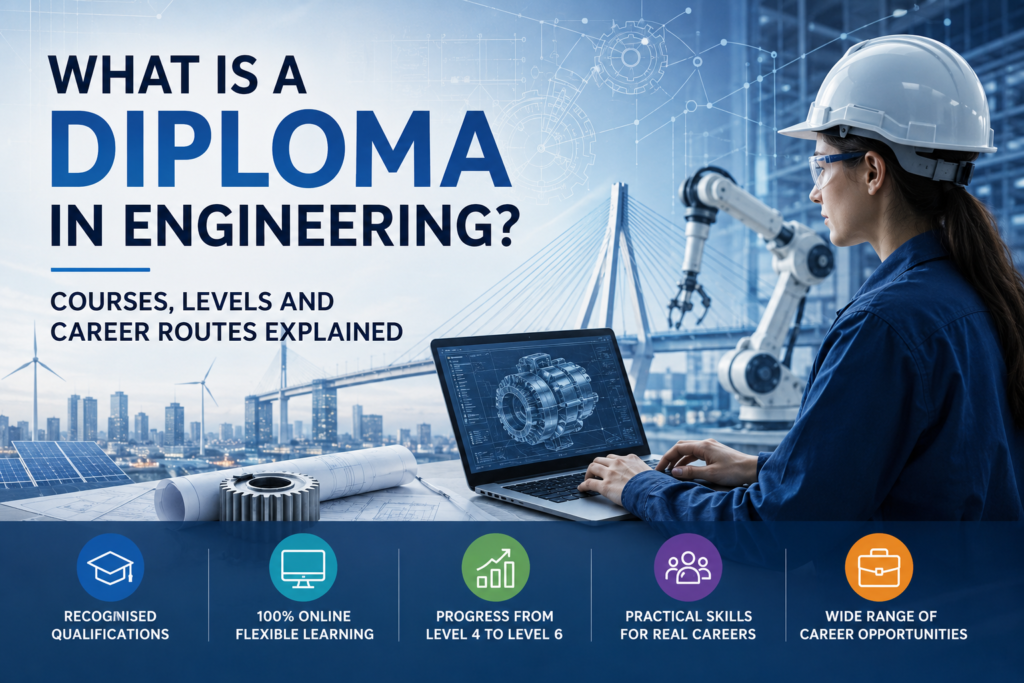
A Diploma in Engineering is one of the most flexible and accessible ways to begin or advance an engineering career. While many people immediately think of a traditional university degree when considering engineering, diploma qualifications offer an alternative route that allows learners to develop recognised academic knowledge step by step, without committing to full-time campus study from the outset.
Engineering itself is one of the broadest and most influential professions in the world. Engineers are responsible for designing aircraft, constructing bridges, developing renewable energy technologies, improving manufacturing systems, creating computer hardware, and solving countless technical challenges that affect everyday life. Because engineering covers such a wide range of disciplines, the educational pathway also needs to be flexible enough to support learners with different ambitions, backgrounds and career goals.
Rather than being a single qualification, an engineering diploma is often part of a progressive learning journey. At iLearn Engineering®, learners can begin with a short specialist diploma before progressing through increasingly advanced qualifications, ultimately reaching a Level 6 International Graduate Diploma equivalent to a bachelor’s degree. This structured approach allows students to build both knowledge and confidence as they move through each stage of study, earning recognised qualifications along the way.
Starting Small: Short Engineering Diplomas
For many learners, the first step is a short Engineering Diploma. These focused qualifications typically consist of 40 credits and concentrate on a specific area of engineering rather than providing a broad overview. They are ideal for professionals looking to gain Continuing Professional Development (CPD), technicians wishing to expand their knowledge, or individuals who simply want to explore a new engineering discipline before committing to a larger programme.
Because these diplomas focus on a particular subject, learners can quickly gain specialist knowledge in areas such as Mechanical Engineering, Electrical and Electronic Engineering, Engineering Design, Fluid Mechanics, Aircraft Design, Artificial Intelligence, Civil Engineering or Renewable Energy. Rather than studying a wide range of topics simultaneously, students can immerse themselves in one particular area and develop practical theoretical understanding that can immediately benefit their careers.
Building Foundations: Higher International Certificate (EduQual Level 4)
Once learners are ready to study engineering in greater depth, they can progress to the Higher International Certificate. Accredited at EduQual Level 4, this qualification represents approximately the first year of university-level engineering education and provides the academic foundations required for more advanced study.
Every Higher International Certificate begins by developing the core engineering principles that every engineer needs. Students study Engineering Design & Ethics, Engineering Mathematics and Engineering Science, creating the mathematical and scientific foundation upon which specialist engineering knowledge is built.
From there, each engineering discipline follows its own specialist pathway. Mechanical Engineering students continue with Structural Mechanics & Dynamics and Machines and Systems, while Electrical and Electronic Engineering learners progress into Electrical & Electronic Engineering Principles and Electrical Machines. Aerospace students study Aerospace Structures and Flight Mechanics, Civil Engineering students move into Introduction to Civil Engineering Projects, Civil Structural Analysis and Construction Methods and Materials, while Industrial Engineering learners focus on Manufacturing Engineering Principles and Manufacturing Systems and Lean Manufacturing. Computer Engineering students develop programming knowledge through Introduction to Programming, Computer Science, Electrical & Electronic Engineering Principles and Robots & Control.
At this stage, engineering begins to transform from individual technical subjects into an integrated way of thinking. Students learn how mathematics supports engineering calculations, how scientific principles explain the behaviour of engineering systems, and how design decisions influence the performance, safety and reliability of products and infrastructure. Rather than simply learning isolated facts, they begin developing the analytical thinking and structured problem-solving skills that define professional engineers.
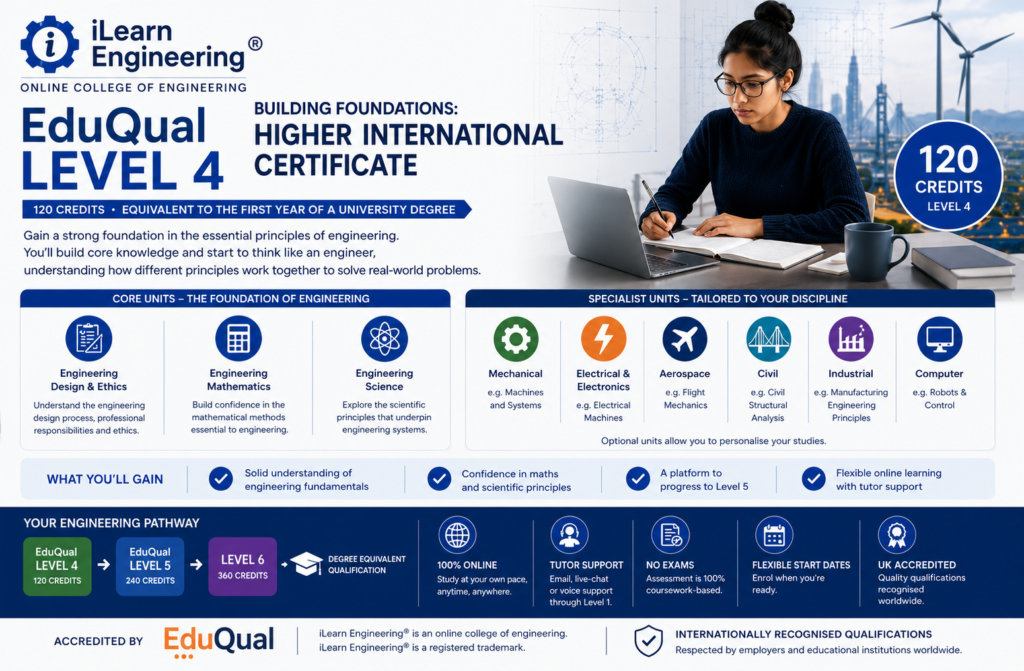
At this stage, you are no longer just learning isolated concepts, you are beginning to think like an engineer, understanding how different principles work together to solve real-world problems.
Advancing Your Knowledge: Higher International Diploma (EduQual Level 5)
The next milestone is the Higher International Diploma, accredited at EduQual Level 5 and comprising 240 credits. This qualification extends the Higher International Certificate by adding another 120 credits of advanced study, broadly equivalent to the first two years of a university engineering degree or a Higher National Diploma (HND).
At EduQual Level 5 the focus shifts from engineering fundamentals towards professional engineering practice. Every learner studies Research Skills and Project Management alongside Engineering Management, helping them develop the planning, communication and organisational skills expected within modern engineering organisations.
Specialist study also becomes increasingly advanced. Mechanical Engineering students investigate Engineering Materials and their Properties together with Fluid Mechanics. Aerospace Engineering learners progress into Aircraft Design and Manufacture alongside Aerodynamics, Propulsion and Space. Electrical and Electronic Engineering students develop their knowledge through Digital Engineering and Electronic Circuits and Renewable Energy Electrical Systems, while Civil Engineering learners study Civil Engineering Infrastructure and Heating Ventilation and Air-conditioning (HVAC). Industrial Engineering students focus on Engineering Materials and their Properties together with Quality, Process Capability, and Process Improvement, while Computer Engineering students explore Digital Engineering and Electronic Circuits alongside IoT & Data Science.
By this stage, learners are applying engineering knowledge to increasingly complex scenarios, developing the confidence to manage technical projects, evaluate engineering systems and understand the wider commercial and organisational environment in which engineering operates.
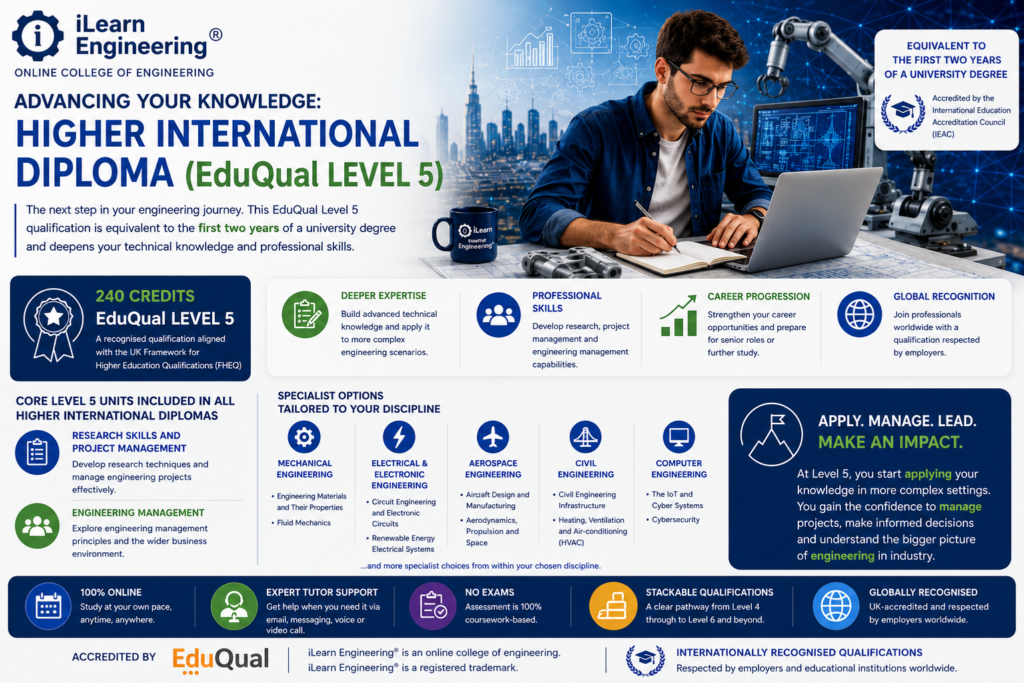
At this stage, the focus shifts towards applying your knowledge in more complex scenarios. You begin to develop the confidence to tackle larger problems, manage projects, and understand the broader context in which engineering operates
Reaching Degree Level: International Graduate Diploma (Level 6)
For those who wish to go further, the International Graduate Diploma represents the culmination of the diploma pathway. This Level 6 qualification is equivalent to a bachelor’s degree and equips you with advanced knowledge and highly sought-after skills.
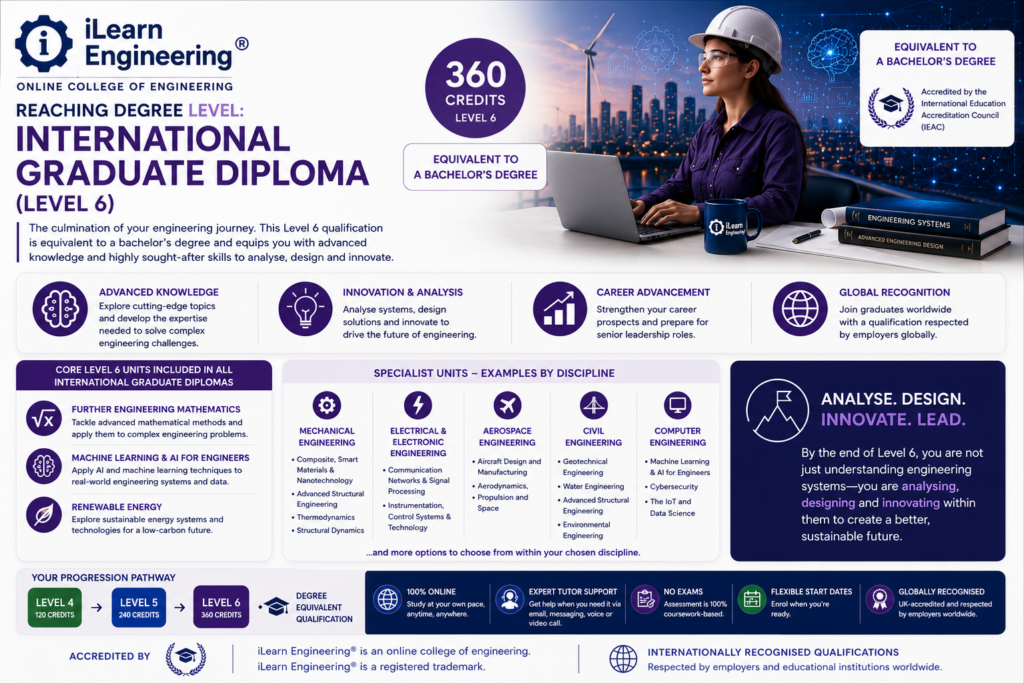
This Level 6 qualification is designed for those who want to build advanced engineering knowledge, strengthen their professional confidence and work towards degree-level understanding in a specialist engineering field.
At this stage, the focus moves beyond core engineering principles and into more advanced, industry-relevant study. Learners develop the ability to analyse complex engineering problems, evaluate technical solutions and apply their knowledge to realistic professional scenarios. This makes the IGD a strong option for learners who want to progress their engineering career, prepare for further study, or demonstrate higher-level technical capability.
Across the International Graduate Diploma pathway, learners study forward-looking topics such as Further Engineering Mathematics, Machine Learning and AI for Engineers, and Renewable Energy. These subjects reflect the changing direction of the engineering industry, where digital technologies, automation, artificial intelligence and sustainable energy systems are becoming increasingly important.
The IGD also allows learners to focus on a specific engineering discipline. Those studying International Graduate Diploma in Mechanical Engineering (Level 6) develop advanced knowledge linked to mechanical systems, design, materials, energy and applied engineering problem-solving. This route is suited to learners interested in areas such as manufacturing, product design, maintenance engineering, mechanical systems and engineering management.
Learners following International Graduate Diploma in Aerospace Engineering (Level 6) explore higher-level concepts connected to aircraft systems, aerodynamics, propulsion, aerospace design and the wider aviation and space sectors. This pathway is ideal for those who want to develop specialist knowledge in one of the most technically demanding areas of engineering.
The International Graduate Diploma in Electrical and Electronic Engineering (Level 6) route focuses on advanced electrical, electronic and digital systems. Learners may explore areas such as communications, networks, signal processing, renewable energy systems and electronic technologies. This pathway supports career development in sectors such as power, automation, telecommunications, electronics and embedded systems.
For learners interested in the built environment, International Graduate Diploma in Civil Engineering (Level 6) provides advanced study linked to infrastructure, structures, construction, sustainability and engineering design. This route is particularly relevant to those aiming to work in areas such as structural engineering, construction management, transport infrastructure, environmental engineering or public works.
Similar Level 6 programmes are also available for learners seeking broader progression routes. The International Graduate Diploma in Engineering Management (Level 6) is ideal for those who want to combine advanced engineering knowledge with leadership, project management and organisational skills. For learners who do not wish to follow a highly specialised pathway, the International Graduate Diploma in Engineering (Level 6) offers a flexible option, allowing them to develop advanced engineering knowledge while keeping their career direction broad.
By the end of the Level 6 International Graduate Diploma, learners are not simply understanding engineering concepts in isolation. They are developing the ability to apply advanced knowledge, evaluate technical information, manage complex problems and think more strategically about the role of engineering in industry. This makes the IGD pathway a valuable option for learners who want a flexible, career-focused alternative to traditional university study, while still working towards advanced engineering knowledge at degree level.
Where Can an Engineering Diploma Take You?
One of the most compelling aspects of an engineering diploma is the range of opportunities it opens up. Each level of qualification brings new career possibilities and progression routes.
At an entry level, you might step into roles such as an engineering technician or junior designer. As you progress to higher levels, opportunities expand into positions like project engineer or design engineer. With a Level 6 qualification, you could move into senior roles, leadership positions, or specialist areas within your chosen field.
Importantly, the pathway does not close doors, it opens them. Many learners choose to continue their studies further, applying for university top-up degrees or transitioning into new engineering disciplines as their interests evolve.
A Flexible Alternative to Traditional Study
What sets the engineering diploma route apart is its accessibility. With no fixed timetables, no exams, and flexible start dates, it is designed for modern learners, whether you are working full-time, changing careers, or returning to education after a break.
The open-access nature of many courses means you can begin without traditional entry qualifications, building your knowledge from the ground up with full tutor support available throughout your journey.
A Diploma in Engineering is not just a qualification, it is a pathway. It allows you to start where you are, progress at your own pace, and build towards a recognised, degree-level achievement.
In a world where engineering skills are in high demand, this flexible and structured approach provides a practical route into the industry without the constraints of traditional education.
Whether you take your first step with a short diploma or aim for a full Level 6 qualification, you are investing in a future shaped by innovation, problem-solving, and opportunity.
Accreditation.
The iLearn Engineering pathway is built on a foundation of internationally recognised academic standards, ensuring that learners progress through a structured and credible qualification journey from Level 4 to Level 6. Each stage aligns with global higher education frameworks, meaning students are effectively completing the equivalent of the first, second, and final years of a university degree. This staged approach not only supports flexible learning but also guarantees that academic development is consistent, rigorous, and recognised worldwide.
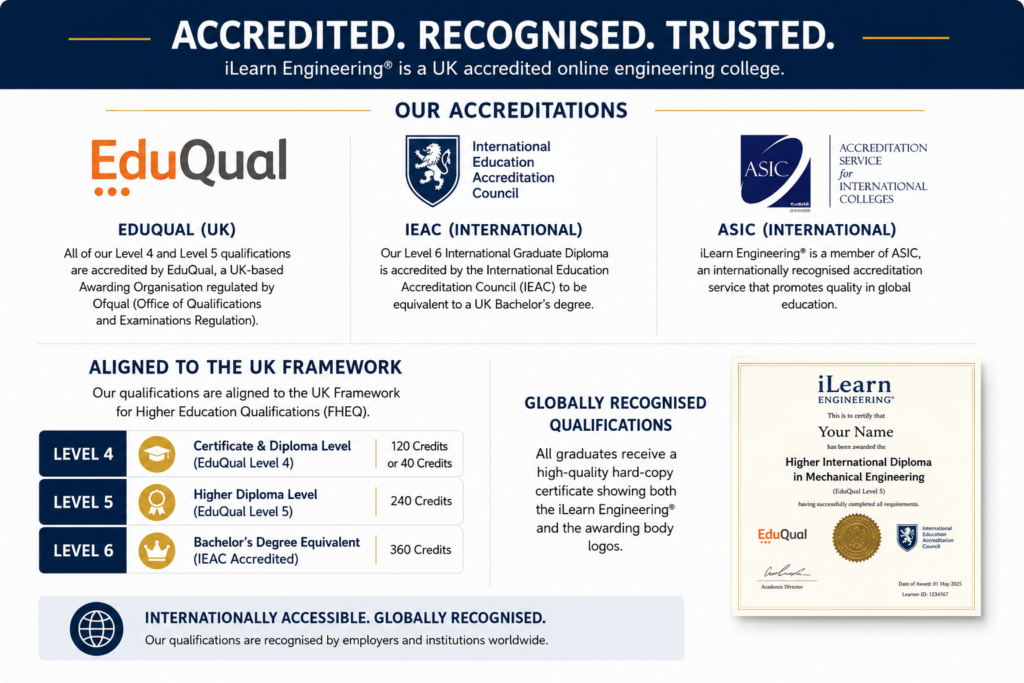
The global recognition of these qualifications opens significant academic and professional doors. Learners who complete EduQual Level 4 and EduQual Level 5 can seamlessly progress into university degree programmes, often entering directly into the final year through top-up arrangements. Upon completing Level 6, students hold a qualification equivalent to a full bachelor’s degree, which can lead to postgraduate study or immediate entry into professional engineering roles.
Importantly, the programme is not purely academic. It is designed with strong industry relevance, embedding practical skills, modern engineering concepts, and real-world applications throughout the curriculum. This ensures that graduates are not only qualified on paper but are also equipped with the competencies needed to succeed in today’s engineering environment.
Quality assurance remains a continuous process across all levels. From moderated assessments to clearly defined learning outcomes, every aspect of the programme is monitored and reviewed to maintain high standards. This commitment to quality reinforces the credibility of the qualification and supports learners in achieving meaningful academic and career progression.
Overall, the iLearn Engineering® accreditation and recognition framework provides a clear, trusted pathway from foundational study through to degree-level achievement, combining academic excellence with real-world applicability.
Recent Posts
Types of Aircraft Drag Explained: Induced, Profile and Interference Drag
Types of Aircraft Drag Explained: Induced, Profile and Interference Drag An aircraft experiences several forms of aerodynamic drag at the same time. Some result from generating lift, some arise as air flows over the aircraft’s surfaces, and others are created when airflow around neighbouring components interacts. For a conventional aircraft in subsonic flight, total drag […]
Induced Drag Explained: Why Flying Slower Can Increase Drag
Induced Drag Explained: Why Flying Slower Can Increase Drag Why can an aircraft experience more drag when it flies more slowly? We usually associate greater speed with greater air resistance, but a wing must also generate enough lift to support the aircraft. Induced drag is the drag associated with producing lift on a finite-span wing. […]
Laminar vs Turbulent Boundary Layers: Why Airflow Separates from Aircraft Wings
Laminar vs Turbulent Boundary Layers: Why Airflow Separates from Aircraft Wings Airflow around an aircraft wing is often shown as smooth streamlines passing neatly over the aerofoil. In reality, the thin layer of air immediately next to the wing surface behaves very differently from the undisturbed airflow further away. This region is called the boundary […]