

What Are Complex Numbers and Why Do Engineers Use Them?
Complex numbers can appear abstract when they are first encountered. After all, how can the square root of a negative number represent anything useful in the real world?
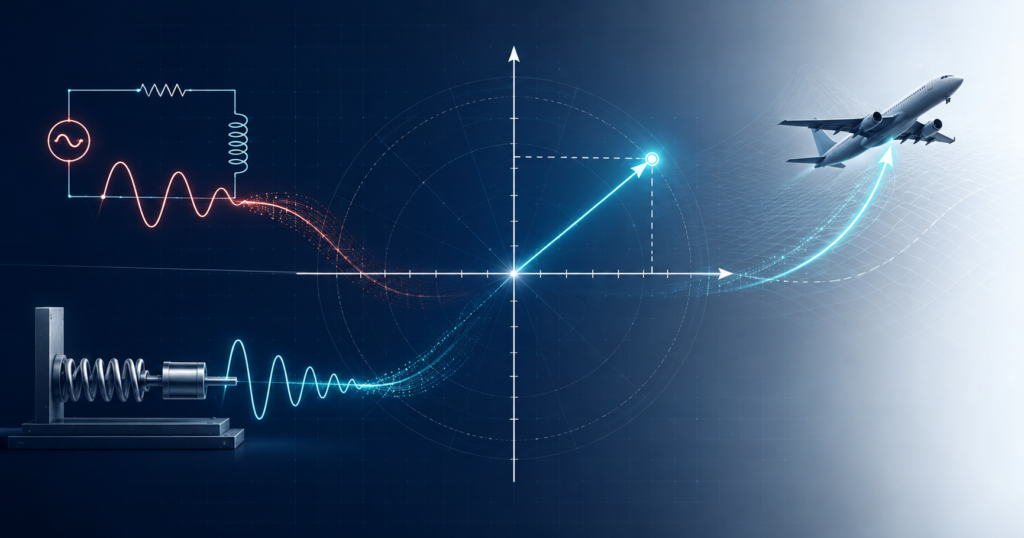
For engineers, complex numbers are not merely a mathematical curiosity. They provide an efficient way to represent quantities that have two connected components, such as magnitude and phase, resistance and reactance, or decay rate and oscillation frequency. This makes them particularly valuable when analysing alternating-current circuits, mechanical vibration, aircraft stability, control systems, waves and signals.
What is a complex number?
A complex number consists of a real part and an imaginary part. In Cartesian form, it is written as:
$$ z = a + bi $$
Here, $z$ is the complex number, $a$ is its real part, $b$ is the coefficient of its imaginary part and $i$ is the imaginary unit.
The imaginary unit is defined by:
$$ i^2 = -1 $$
This extends the real number system so that equations with no real-number solutions can still be solved. For example:
$$ x^2 + 1 = 0 $$
Rearranging gives:
$$ x^2 = -1 $$
Therefore:
$$ x = \pm i $$
The word “imaginary” can be misleading. It does not mean that these numbers are fictional or physically meaningless. It simply distinguishes the imaginary component from the real component.
Understanding Cartesian form
The expression $z=a+bi$ is known as the Cartesian or rectangular form of a complex number. Its two components can be shown on a complex plane, also known as an Argand diagram.
The horizontal axis represents the real component, while the vertical axis represents the imaginary component. The complex number $3+2i$, for example, can be represented by the point $(3,2)$.
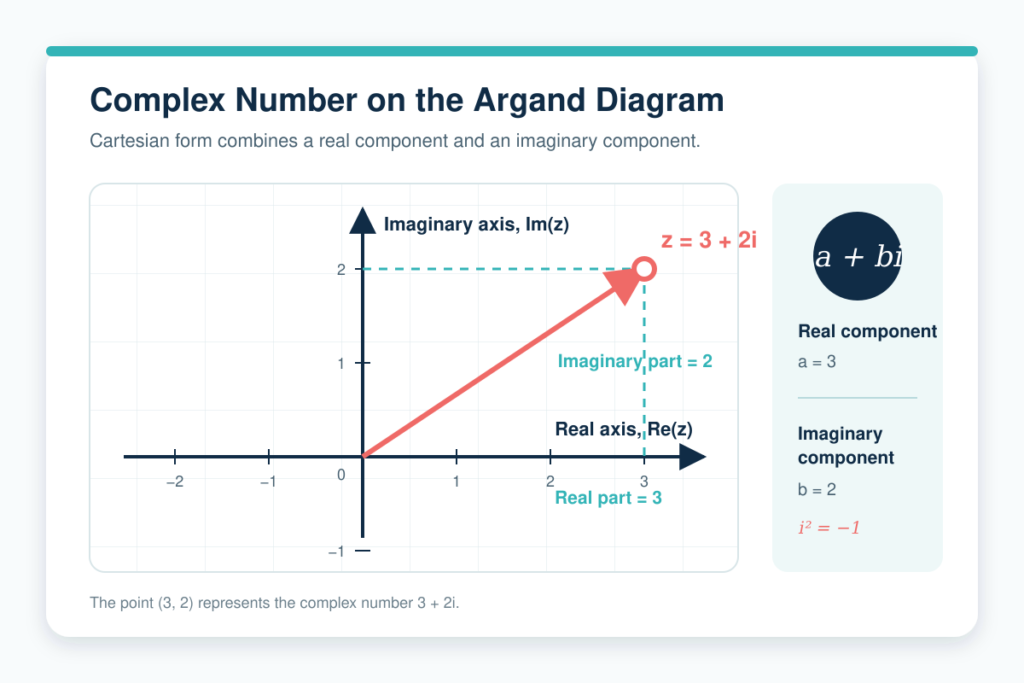
This two-dimensional representation is one reason complex numbers are useful in engineering. A single complex value can carry information about two related quantities without requiring two separate equations.
The magnitude of $z=a+bi$ is:
$$ |z| = \sqrt{a^2+b^2} $$
Its angle, or argument, is:
$$ \theta = \tan^{-1}\left(\frac{b}{a}\right) $$
In practice, the signs of $a$ and $b$ must be considered to place the angle in the correct quadrant. Engineering software commonly uses a two-argument arctangent function for this purpose.
Magnitude and angle become especially important when complex numbers are used to represent sinusoidal signals, rotating vectors and frequency responses.
How are complex numbers calculated?
In Cartesian form, the real and imaginary components are handled separately during addition and subtraction.
Consider:
$$ z_1 = 3 + 2i $$
and:
$$ z_2 = 1 – 4i $$
Their sum is:
$$ z_1 + z_2 = (3+1)+(2-4)i $$
Therefore:
$$ z_1 + z_2 = 4-2i $$
Multiplication uses the ordinary rules of algebra together with $i^2=-1$:
$$ (3+2i)(1-4i) $$
Expanding the brackets gives:
$$ 3-12i+2i-8i^2 $$
Because $i^2=-1$, the final term becomes positive:
$$ (3+2i)(1-4i)=11-10i $$
These operations may look unfamiliar initially, but they allow engineers to solve calculations involving both amplitude and phase using standard algebra.
Why do electrical engineers use complex numbers?
Complex numbers are widely used in alternating-current (AC) circuit analysis. In electrical engineering, the imaginary unit is normally written as $j$ rather than $i$, because $i$ is conventionally used to represent electric current.
Electrical impedance can be expressed as:
$$ Z = R+jX $$
Here, $R$ is resistance and $X$ is reactance. Reactance describes the opposition to AC caused by capacitance or inductance.
For example, suppose a circuit has an impedance of:
$$ Z = 8+j6\ \Omega $$
Its magnitude is:
$$ |Z|=\sqrt{8^2+6^2} $$
Therefore:
$$ |Z|=10\ \Omega $$
Its phase angle is:
$$ \theta=\tan^{-1}\left(\frac{6}{8}\right)=36.9^\circ $$
The single complex value $8+j6$ therefore contains information about both the magnitude of the impedance and its phase relationship.
This approach is much more efficient than repeatedly manipulating sine and cosine expressions. Massachusetts Institute of Technology teaching materials demonstrate how complex numbers and phasors simplify the analysis of linear systems and sinusoidal electrical quantities.[1]
Readers who are new to electrical calculations may find it useful to review basic electrical parameters in DC circuits before progressing to phasors and the trigonometric representation of periodic waveforms.
Why are complex numbers useful in mechanical engineering?
Mechanical systems often involve vibration, oscillation and resonance. Examples include rotating machinery, vehicle suspension systems, turbine shafts and flexible structures.
A vibrating response may be represented using a complex exponential:
$$ x(t)=\operatorname{Re}\left\{Xe^{j\omega t}\right\} $$
Here, $X$ is a complex amplitude, $\omega$ is angular frequency and $\operatorname{Re}$ means that the real part of the expression represents the physical displacement.
Euler’s relationship connects the complex exponential to familiar trigonometric functions:
$$ e^{j\theta}=\cos\theta+j\sin\theta $$
This allows sinusoidal motion and its derivatives to be handled compactly. Differentiation becomes multiplication by $j\omega$, which can greatly simplify vibration and frequency-response calculations.
Complex roots also reveal important information about dynamic behaviour. A pair of roots may be written as:
$$ s=-\sigma\pm j\omega_d $$
This describes an oscillation whose amplitude decays over time. The real component $-\sigma$ controls the rate of decay, while the imaginary component $\omega_d$ relates to the oscillation frequency.
This is directly connected to practical concepts such as damping and resonance in mechanical systems.
How do aerospace engineers use complex numbers?
Aircraft and spacecraft are dynamic systems. Their motion can include oscillatory modes associated with pitch, roll, yaw, structural vibration and control-system response.
When engineers build mathematical models of these systems, the resulting characteristic equations can have complex roots or eigenvalues. Their positions in the complex plane help describe whether a disturbance will decay, persist or grow.
For a continuous-time linear system, poles in the left half of the complex plane normally indicate a decaying response, while poles in the right half indicate an unstable response. Pole-zero plots are therefore useful when examining stability, damping and natural frequency.[2]
In aircraft dynamics, complex modes can help describe oscillatory behaviour such as short-period and phugoid motion. These ideas connect mathematical analysis with the physical behaviour described in aircraft longitudinal stability.
Complex-number methods are also applied to aeroelasticity, structural dynamics, navigation, communications and flight-control design.
Complex numbers in control systems
Control engineers use transfer functions to describe the relationship between the input and output of a system. A typical transfer function may be written as:
$$ G(s)=\frac{N(s)}{D(s)} $$
The variable $s$ can be complex:
$$ s=\sigma+j\omega $$
The roots of $N(s)$ are called zeros, while the roots of $D(s)$ are called poles. Plotting these values in the complex plane helps engineers assess system stability and dynamic response.
Complex poles often occur in conjugate pairs:
$$ s=-\sigma\pm j\omega_d $$
This pair represents an oscillatory response. Its real component indicates whether the oscillation grows or decays, while its imaginary component relates to frequency. Engineers use this information when designing controllers for industrial machinery, robots, vehicles, aircraft and electrical systems.
Complex numbers in signal processing and communications
Signals frequently contain information about both amplitude and phase. Complex numbers provide a natural way to retain both.
Fourier analysis represents a signal as a combination of sinusoidal components at different frequencies. Complex exponentials make those components easier to manipulate mathematically. This supports applications including audio processing, telecommunications, radar, vibration measurement, image processing and fault diagnosis.
A complex signal may be written as:
$$ z(t)=x(t)+jy(t) $$
The real component $x(t)$ and imaginary component $y(t)$ can represent two related signal channels. In communications engineering, these are often called the in-phase and quadrature components.
For further background on repeating signals, see the engineering principles of periodic waveforms.
Are complex numbers physically real?
A complex number is usually a mathematical representation rather than a directly measurable physical quantity. Engineers ultimately interpret the result in terms of measurable values such as voltage, current, displacement, force or acceleration.
However, the mathematical representation is extremely useful because it preserves relationships that would otherwise require several simultaneous real-number equations.
The usefulness of complex numbers is therefore not based on whether the imaginary component exists independently as a physical object. It comes from their ability to model real systems accurately and efficiently.
Developing engineering mathematics skills
Complex numbers are part of a wider mathematical toolkit used across engineering. Learners who want to study this subject in depth can begin with the Diploma in Engineering Mathematics, which includes complex numbers, matrices, differential equations and other applied mathematical methods.
For a broader mechanical pathway, iLearn Engineering® offers the Higher International Certificate in Mechanical Engineering, Higher International Diploma in Mechanical Engineering and International Graduate Diploma in Mechanical Engineering.
Learners interested in aircraft, flight dynamics and aerospace systems can consider the Higher International Certificate in Aerospace Engineering, Higher International Diploma in Aerospace Engineering or International Graduate Diploma in Aerospace Engineering.
For applications involving circuits, electronics, signals and control, suitable routes include the Higher International Certificate in Electrical and Electronic Engineering, Higher International Diploma in Electrical and Electronic Engineering and International Graduate Diploma in Electrical and Electronic Engineering.
View all iLearn Engineering courses to compare the available study routes.
Frequently asked questions
What is a complex number in simple terms?
A complex number combines a real component and an imaginary component. It is commonly written as $z=a+bi$, where $a$ and $b$ are real numbers and $i^2=-1$.
Why do engineers need imaginary numbers?
Imaginary numbers allow engineers to represent and calculate quantities involving phase, oscillation and frequency. They simplify problems involving AC circuits, vibrations, control systems and signals.
Why do electrical engineers use j instead of i?
Electrical engineers commonly reserve $i$ for current. They therefore use $j$ for the imaginary unit, with $j^2=-1$.
What is the difference between Cartesian and polar form?
Cartesian form expresses a complex number through its real and imaginary components. Polar form expresses the same number through its magnitude and angle. Cartesian form is convenient for addition and subtraction, while polar form is often more convenient for multiplication and division.
Can complex-number calculations produce real engineering results?
Yes. Complex numbers are used as an intermediate mathematical tool. The final result can be interpreted as a measurable voltage, current, displacement, force, frequency or other physical quantity.
References
[1] Massachusetts Institute of Technology OpenCourseWare – Linear systems, complex numbers and phasors
[2] MathWorks – Pole and zero locations
Interested in our engineering courses?
We have over 70 courses across all major engineering disciplines, including, mechanical, electrical and electronic, civil, aerospace, industrial, computer and general engineering. Visit our course catalogue for a complete list of fully accredited engineering programmes.
A small selection of short Engineering courses …
Diploma in Mechanical Engineering
Diploma in Aerospace Engineering
Level 6 Engineering Courses
International Graduate Diploma in Mechanical Engineering
International Graduate Diploma in Aerospace Engineering
Level 5 Engineering Courses
Higher International Diploma in Mechanical Engineering
Higher International Diploma in Aerospace Engineering
Level 4 Engineering Courses
Higher International Certificate in Mechanical Engineering
Higher International Certificate in Aerospace Engineering
View Engineering Courses
Explore our UK-accredited engineering courses. 100% Online with no schedules, no deadlines and no exams.
Recent Posts
Why a Headwind Reduces Take-Off Distance: The Airspeed–Groundspeed Derivation
Why a Headwind Reduces Take-Off Distance: The Airspeed–Groundspeed Derivation Aeroplanes normally take off into wind because the wing must reach a required airspeed to produce lift, whereas the runway distance is travelled at groundspeed. A headwind contributes to the airspeed before the aircraft has covered any runway. It therefore reduces the groundspeed required at lift-off […]
How to Calculate Aircraft Take-Off Ground Run: A Flight Mechanics Tutorial
How to Calculate Aircraft Take-Off Ground Run: A Flight Mechanics Tutorial An aircraft does not become airborne simply because its engines are producing thrust. During the take-off ground run, thrust must overcome aerodynamic drag and rolling resistance. On a sloping runway, it must also overcome a component of the aircraft’s weight. This tutorial derives a […]
Types of Aircraft Drag Explained: Induced, Profile and Interference Drag
Types of Aircraft Drag Explained: Induced, Profile and Interference Drag An aircraft experiences several forms of aerodynamic drag at the same time. Some result from generating lift, some arise as air flows over the aircraft’s surfaces, and others are created when airflow around neighbouring components interacts. For a conventional aircraft in subsonic flight, total drag […]